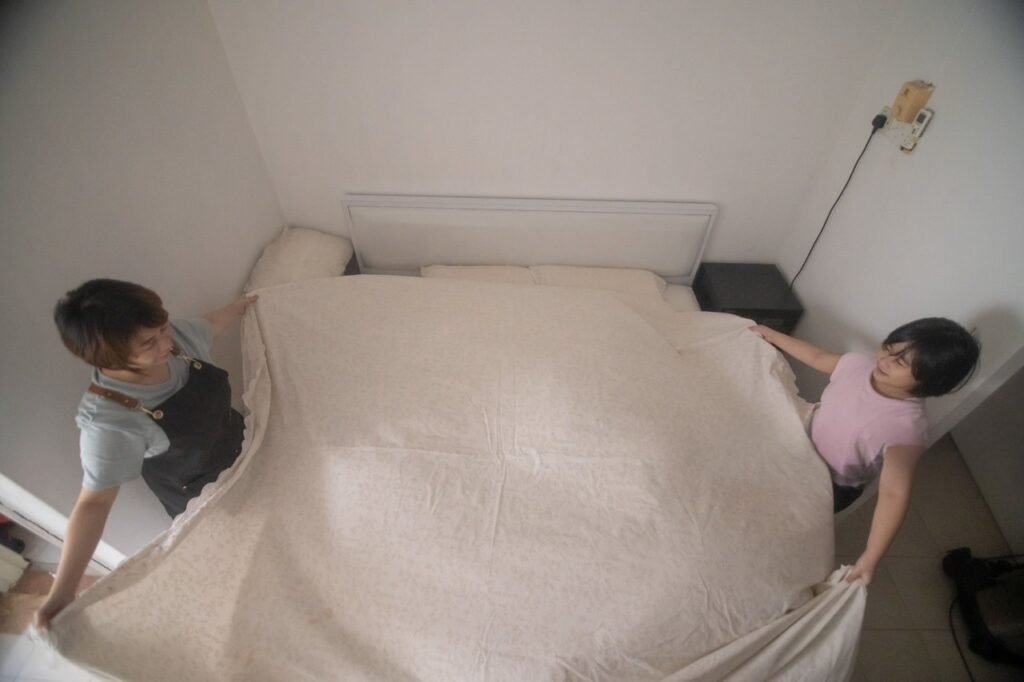
It was three in the morning, and I was engaged in hand-to-hand combat with my own bed.
Not with a nightmare, not with a restless partner, but with a single, insidious corner of my fitted sheet. It had staged a silent coup while I slept, working its way loose from the mattress like a prisoner digging a tunnel with a spoon. Now, a significant portion of the bottom corner was bunched up under my shoulder blade, a wrinkled, elastic-rimmed accusation against my life choices.
I let out a groan that was half-sleep, half-primal frustration. In the darkness, I kicked at the offending fabric, a clumsy, half-hearted maneuver that only succeeded in tangling my feet further. With a sigh that carried the weight of a thousand petty domestic grievances, I sat up. The cool air of the room hit my back, which was now exposed to the elements. My partner, blessedly, slept on, a still-life of peace beside my quiet chaos.
I peeled back the duvet. There it was. The corner of the sheet had popped off with such enthusiasm that it had traveled a good six inches up the side of the mattress, leaving the corner of the memory foam exposed like a bald patch on a well-loved teddy bear. I grabbed the loose corner, the elastic straining against my fingers, and yanked it back down. I tucked it with more force than finesse, wedging the fabric as far under the mattress as I could. I flopped back onto my pillow, heart beating a little faster than it should for 3 a.m., and stared at the ceiling.
The peace, however, was temporary. It always was. It’s a ritual as old as fitted sheets themselves: the nightly truce, followed by the inevitable betrayal.
We’ve all been there. That moment when you swing your legs out of bed in the morning, only to feel the familiar, dreaded sensation of the sheet rising with you, clinging to your heel like a needy pet. Or you walk into the bedroom after a long day, and your bed looks less like a sanctuary and more like a crime scene, the sheet having retreated from one corner entirely, creating a lopsided, sad little tent. I call it the Sheet Pop-Off. It is a silent war, a battle of wills between human and home textile, and for years, I was losing.
My journey to end this war didn’t begin with a white flag. It began with a measuring tape, a series of frankly embarrassing returns to home goods stores, and a deep, humbling dive into the surprisingly complex world of fitted sheet dimensions. I thought a sheet was a sheet. You have a bed, you buy a sheet for that bed. Easy. Right?
Wrong. So terribly, catastrophically wrong.
It all came to a head (or rather, a corner) after my partner and I upgraded our mattress. After years of a lumpy, full-size relic from our college days, we finally invested in a glorious, queen-size mattress. It was a moment of great pride. We stood in the showroom, testing the firmness, discussing the merits of pillow-top versus Euro-top, feeling like true adults. We settled on a plush, pillow-top model. It was deep, luxurious, and promised nights of unbroken sleep. We paid, we waited for delivery, and on the day it arrived, we made our bed with the ceremony of a royal coronation.
We pulled out the brand-new, 1000-thread-count queen-size fitted sheet we’d bought the week before in anticipation. It was a crisp, beautiful shade of slate blue. My partner took one corner, I took the opposite. With a synchronized flourish, we dropped it over the mattress. It was a perfect fit. The corners seated themselves with a satisfying snap of elastic. We smoothed it out, tucked in the sides, and stood back to admire our work. The bed looked like it belonged in a catalog. We crawled in that night, sighing with contentment, the plush new mattress cradling us, the smooth sheet promising a dreamless sleep.
I woke up three hours later, my back cold, my spirit crushed. The Sheet Pop-Off had happened again, but this time, it was worse. The sheet hadn’t just lost a corner; it had practically unpeeled itself from the top of the bed. The entire top edge was rolled down like a scroll, exposing the mattress’s pillow-top. I was sleeping on a bare mattress with a wad of slate-blue cotton bunched at my feet.
“What is wrong with this sheet?” I whispered furiously into the dark, as if the sheet could answer for its crimes.
The next morning, I examined the packaging. It said “Queen.” I looked at our mattress, which was, undeniably, a queen. So why the betrayal? I was about to blame the sheet’s elastic, to curse the decline of modern manufacturing, when a wiser, more desperate part of my brain took over. I grabbed a measuring tape.
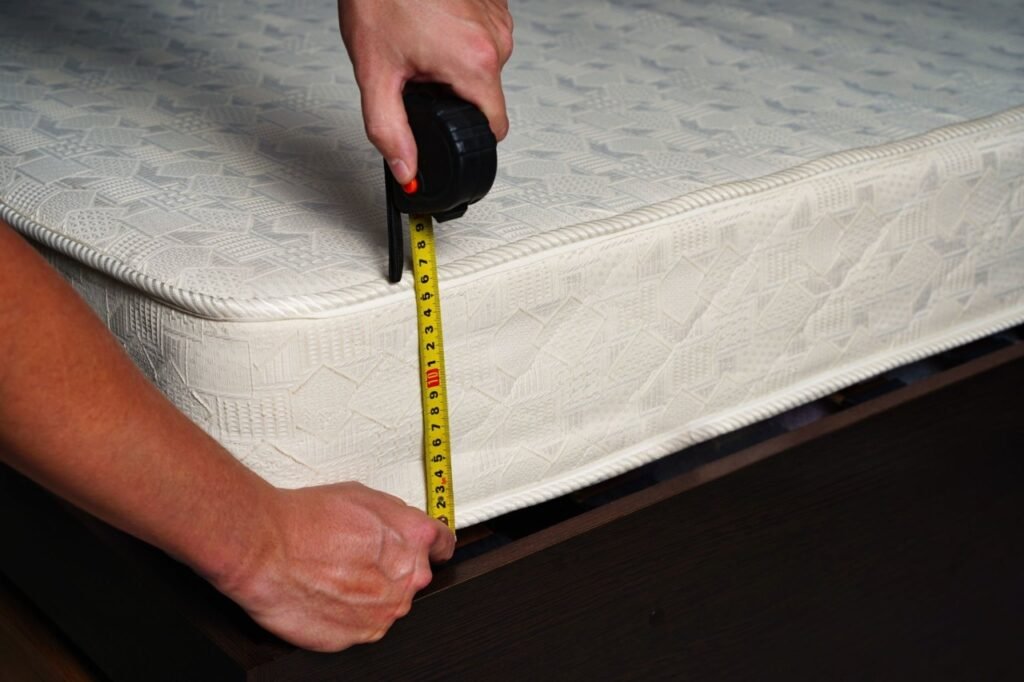
I measured the mattress. It was 60 inches wide, 80 inches long—standard queen dimensions. Then, on a hunch, I measured its depth. From the top of the pillow-top seam to the bottom of the mattress, I got 14 inches. That seemed deep. I then picked up the slate-blue culprit and looked at the packaging again. Buried in the fine print, in a font so small it seemed intentionally concealed, it read: “Fits mattresses up to 12 inches deep.”
There it was. The smoking gun. My mattress was two inches too deep for the sheet. The elastic, designed to grip a standard 10-to-12-inch mattress, was being pulled to its absolute limit. It was stretched so taut over the extra depth that the slightest movement—the shift of a sleeping body, the mere act of breathing—was enough to snap it over the edge. I hadn’t bought a bad sheet; I’d bought the wrong sheet. It was like trying to put a fitted cap on a giant’s head and being surprised when it popped off.
This realization was my Rosetta Stone. I suddenly understood that the world of fitted sheets was not a simple binary of Twin, Full, Queen, King. It was a sprawling, complex ecosystem of depths, pocket sizes, and industry-specific jargon. I had been navigating it with the ignorance of a tourist who only knows the word for “hello.”
My journey to sheet enlightenment began in earnest that weekend. I went back to the store, but this time, I was not a helpless victim. I was a detective. I stood in the bedding aisle, which suddenly felt less like a home goods section and more like a foreign country with its own currency and customs. I picked up package after package, turning them over like sacred texts.
I learned about “pocket depth.” This, I discovered, is the single most important number for a fitted sheet. It’s the measurement from the top edge of the sheet (the part that sits on the top surface of the mattress) down to the sewn-in elastic. A sheet with a 12-inch pocket depth will fit a mattress up to 12 inches tall perfectly. For my 14-inch mattress, I needed a sheet with a pocket depth of at least 14 inches. Ideally, I learned, you want a pocket depth that matches or slightly exceeds your mattress depth. A little extra is fine; the elastic will still grip. But too little, and you’re destined for the dreaded Pop-Off.
I started seeing numbers I’d never noticed before. Standard sheets—the ones you find in most big-box stores—typically have a pocket depth of 12 to 14 inches. But the bedding industry, much like the mattress industry, has undergone a revolution. Mattresses have gotten taller. They’re no longer the flat, 7-to-9-inch boxes of yesteryear. They’re towering affairs, layered with memory foam, pillow-tops, and cooling gels. A “standard” sheet often can’t keep up.
This is where the term “deep pocket” comes in. Deep pocket fitted sheets are designed for mattresses between 14 and 17 inches deep. I grabbed a package that boasted “15-inch pocket depth” and felt a flicker of hope. But I also saw packages labeled “extra deep pocket,” designed for the true behemoths—mattresses up to 22 inches deep, often used in adjustable bed frames or luxury setups.
As I stood there, a woman in a beige vest—a store employee—approached me. “Can I help you find something?” she asked. I held up my failed slate-blue sheet.
“I need a queen sheet that won’t pop off my 14-inch pillow-top mattress,” I said, the words now flowing with the confidence of a native speaker.
She nodded, a knowing look in her eye. “Ah, the fourteen-inch problem. You’re not alone. Most people don’t realize they need a deep pocket until they’ve already bought the standard ones.” She led me to a different section of the aisle, one I’d previously overlooked. “Look for ‘Deep Pocket Queen’ on the label. And pay attention to the elastic.”
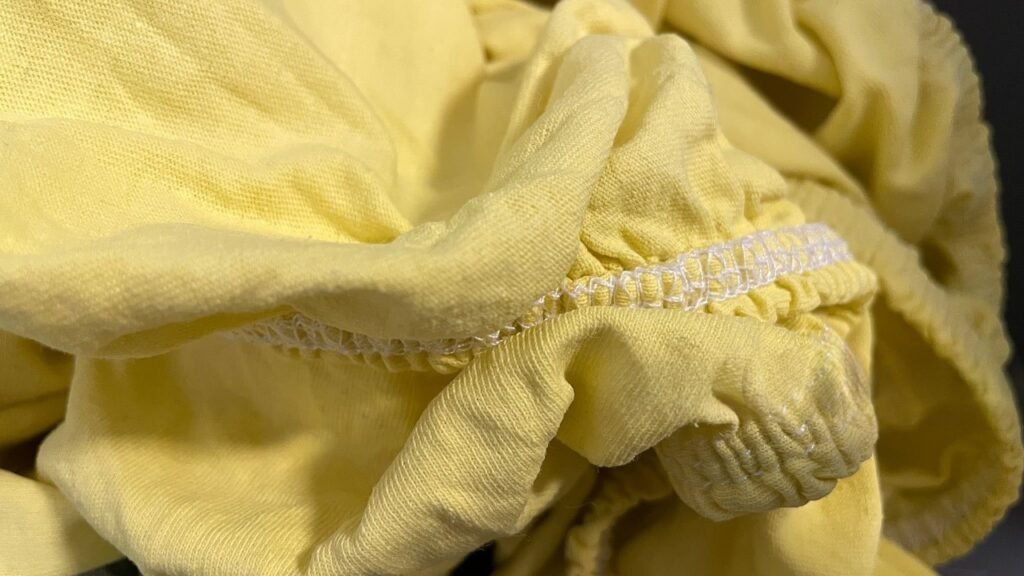
She then imparted a piece of wisdom that changed everything. “It’s not just about the depth of the pocket,” she said, holding up a sheet and pointing to the elastic. “See how this elastic goes all the way around the entire opening? It’s not just sewn into the corners. It’s a continuous band. That’s what you want. It’s like a giant rubber band for your mattress. It distributes the tension evenly all the way around, so there aren’t weak points at the corners.”
I looked at the sheet in my hands. My old sheet had elastic only in the corners. I looked at the deep-pocket sheet she’d shown me. Sure enough, the elastic ran the entire perimeter. It was a revelation. I had been fighting the Sheet Pop-Off with corner guards, with suspenders that clipped under the mattress, with sheer willpower. But the real solution was fundamental: a sheet engineered with full-perimeter elastic, sized precisely for my mattress’s depth.
I bought two sets of deep-pocket queen sheets that day, each with a 15-inch pocket depth and full elastic. I brought them home with a sense of hope that felt almost foolish. Was I really this excited about bed sheets? Yes. Yes, I was. The stakes were high: my sleep, my sanity, and my 3 a.m. dignity.
That night, we made the bed again. The ritual was the same, but the feeling was different. As I fitted the first corner, I felt the generous fabric envelop the thick mattress corner with ease. There was no straining, no desperate stretching. The elastic—that glorious, continuous band—hugged the side of the mattress like it was meant to be there. The second corner went on just as smoothly. My partner, from the other side, reported the same. The sheet sat flush against the surface, no bunching, no tension lines. It was as if the sheet and the mattress had been made for each other. Because, finally, they had.
We slept through the night. The entire night. When I woke up, the first thing I did was not to groan or kick. It was to pat the corners of the bed. They were still there. Secure. Unmoved. I felt a surge of triumph so profound it was almost embarrassing. I had not just solved a household problem; I had conquered a personal demon.
But my journey didn’t end there. With my newfound knowledge, I became a sort of reluctant expert among my friends and family. I was the person they texted a photo of a sheet package from the store, asking, “Is this the right one?” I started noticing that the Sheet Pop-Off was a universal trauma, a shared experience that transcended age, income, and even mattress quality.
My friend Sarah called me in a panic. She had just bought a new “split king” adjustable bed frame with her husband, and she was convinced she would never find sheets that fit. “It’s two twin XL mattresses pushed together!” she wailed. “But they move independently! And the sheets are all for one big king!”
“Welcome to the next level,” I said. I explained that for a split king, you have two options. You can buy two separate twin XL fitted sheets—one for each mattress—and then use a single king-size flat sheet and duvet to cover the whole thing. Or, you can look for specialized “split king” fitted sheets, which are essentially one large sheet sewn with a split in the middle, designed to accommodate the gap and independent movement. I warned her about depth again, reminding her that adjustable bases often have thicker mattresses.
She called me back a week later, her voice thick with gratitude. “You saved my marriage,” she said. I didn’t correct her.
Then there was my brother, a man who prided himself on pragmatism. He called me, confused, after buying a “California King” bed. “Isn’t a king a king?” he asked. This was another pitfall I had discovered in my research. A standard king mattress is 76 inches wide by 80 inches long. A California King is narrower but longer: 72 inches wide by 84 inches long. If you put a standard king sheet on a California King bed, you’ll have a tent-like overhang on the sides and a frustrating shortage at the foot. If you do the reverse, you’ll be stretching the sheet to its breaking point across the width. They are not interchangeable, despite the similar name. I explained this to my brother, and I could practically hear him taking notes.
I even helped my elderly aunt, who had downsized to a “twin XL,” the size commonly used in college dorms. She was frustrated that the sheets she bought seemed to fit, but always came untucked on the sides. I explained that a twin XL is 5 inches longer than a standard twin (39×80 vs. 39×75). She had been buying regular twin sheets, which were too short. The length was the issue, not the width. It’s a subtle distinction, but for a twin XL, it’s everything.
Through all these consultations, my own philosophy on sheets began to form. It wasn’t just about the numbers on the package. It was about developing a system, a set of principles to guide me through the treacherous waters of the bedding aisle.
Principle 1: Know Your Mattress’s Measurements.
Before you even look at a sheet, you must measure your mattress. Not just the length and width, but the depth. Run your hand from the top edge of the mattress down to the bottom, following the side. That number, in inches, is your starting point. Write it down. Keep it in your phone. It is your shield against the Pop-Off.
Principle 2: The Pocket Depth is the Gospel.
Forget the label that just says “Queen.” You must find the “Pocket Depth.” Your sheet’s pocket depth must equal or exceed your mattress depth. If you have a 12-inch mattress, a standard sheet will work. If you have a 14-inch mattress, you need a “deep pocket” sheet (usually 15-17 inches). If you have a 16-inch or thicker mattress, you need an “extra deep pocket” sheet (18 inches or more). I personally prefer to err on the side of too deep. A little extra fabric is easy to tuck under and provides extra security. A sheet that’s too shallow is a lost cause.
Principle 3: Hunt for the Full Elastic.
This is non-negotiable. Turn the sheet inside out. Look at the elastic. Does it only run for a few inches at each corner? Or does it run all the way around the opening? That full-perimeter elastic is your best friend. It acts like a continuous drawstring, gripping the entire mattress with uniform pressure. It’s the difference between a sheet that clings and a sheet that merely sits.
Principle 4: Read the Fine Print for Size Nuances.
A “Queen” is not always a queen. Some manufacturers, particularly in the luxury or organic bedding space, have their own sizing quirks. Always look for the actual dimensions on the package. If it says “Fits Queen Mattresses 60” x 80”,” you’re safe. If it just says “Queen” and gives no dimensions, be wary. This is especially crucial for less common sizes like Olympic Queen (66” x 80”), RV Queen (60” x 75”), or the aforementioned California King.
Principle 5: Don’t Fear the Sheet Suspenders.
Even with the perfect sheet, there are circumstances—like a particularly restless sleeper, an adjustable bed, or a mattress that’s right on the edge of your sheet’s capacity—where you might need backup. Sheet suspenders, those elastic straps with clips that you attach to the corners under the mattress, are not a sign of defeat. They are a strategic reinforcement. They are to sheets what a good belt is to pants. I keep a set on hand for my guest room bed, which has a mattress that’s an awkward 13.5 inches deep—a no-man’s-land between standard and deep pocket. The suspenders provide that extra ounce of insurance, ensuring my guests never wake up wrestling with fabric.
Looking back, my journey from a man defeated by a 3 a.m. sheet uprising to a self-appointed bedding consultant feels like a comedy of errors with a happy ending. It seems so simple now: measure, match, and secure. But the emotional toll of those years of nightly defeats was real. It’s a small thing, a fitted sheet. But a small thing, when it fails you night after night, can feel monumental. It can erode the sanctity of your bedroom, turning your bed from a place of rest into a source of low-grade, constant irritation.
Now, when I make the bed, it’s a meditative act rather than a struggle. I take my deep-pocket queen sheet with its full-perimeter elastic. I slide my hand into the first corner and press it firmly over the corner of the mattress. I feel it seat perfectly, the fabric smooth and the elastic relaxed. I move to the opposite corner, then the next, then the last. There’s no wrestling, no tug-of-war. It’s a simple, satisfying process. When I’m done, I run my hand over the surface. It’s taut. It’s smooth. It looks like it grew there.
The other night, I woke up around 3 a.m. to get a glass of water. As I swung my legs out of bed, I paused. A ghost of my old anxiety flickered through my mind. I instinctively felt for the edge of the sheet with my heel. It was there, tucked securely under the mattress, holding its post. I smiled in the darkness. The Sheet Pop-Off was a thing of the past. I had learned its language, understood its mechanics, and, most importantly, I had found the sheet that was built for the bed I actually had.

So, if you’re reading this, wrestling with your own sheet at an ungodly hour, take heart. The solution is not in stronger clips or more frantic tucking. It’s in a measuring tape and a little bit of knowledge. Go measure your mattress. Write that number down. Then, go forth and find your sheet. Find the one with the pocket depth that matches your life, the one with the elastic that hugs every side. It’s out there. And when you find it, you will sleep. You will sleep deeply, peacefully, and uninterrupted by the silent, fabric-based treachery that has plagued humanity for generations.
And if you happen to wake up in the night, it will only be because you need a glass of water, not because you are locked in mortal combat with a rebellious corner of your own bed. Trust me. I’ve been there. I’ve measured. I’ve learned. And I have never, ever looked back.