A few years ago, my aunt came home glowing with a shopping bag from a department store sale. Inside was a pillowcase, wrapped in glossy packaging with the word “Silk” printed across the front in elegant gold cursive. She’d paid what she thought was a bargain price for something that usually costs a small fortune, and she couldn’t wait to tell everyone about her find. She washed it that same evening, slid it onto her pillow with the kind of ceremony usually reserved for special occasions, and went to sleep expecting the famous silk experience — the coolness against the cheek, the way it’s supposed to glide rather than tug at your hair.
The next morning she woke up a little confused. It didn’t feel quite like the silk scarf her mother had given her decades ago. It felt smooth, yes, almost slippery, but there was something off about it — a faint sheen that looked more plasticky than lustrous, a texture that felt warm rather than cool to the touch. When she checked the tiny label sewn into the seam, in letters so small she needed her glasses, it said: “100% Polyester.” Somewhere between the shelf and her bed, the word “silk” printed boldly on the front had quietly become “satin weave” in the fine print, and satin, as it turns out, had nothing to do with silk at all.
This mix-up isn’t rare. It happens in bedding stores, in bridal shops, in the racks of fast fashion outlets, and even in some higher-end boutiques where you’d expect better. Somewhere along the way, in the collective imagination of shoppers everywhere, satin and silk became interchangeable words for the same shiny, luxurious fabric. But that idea is wrong, and understanding why matters more than most people realize — for your skin, your hair, your wallet, and honestly, your sense of not being fooled.
The Fiber and the Weave: Two Completely Different Things
To understand the confusion, you have to go back to a distinction that most of us were never taught in school: the difference between a fiber and a weave. It sounds like a technicality, but it’s the whole story.
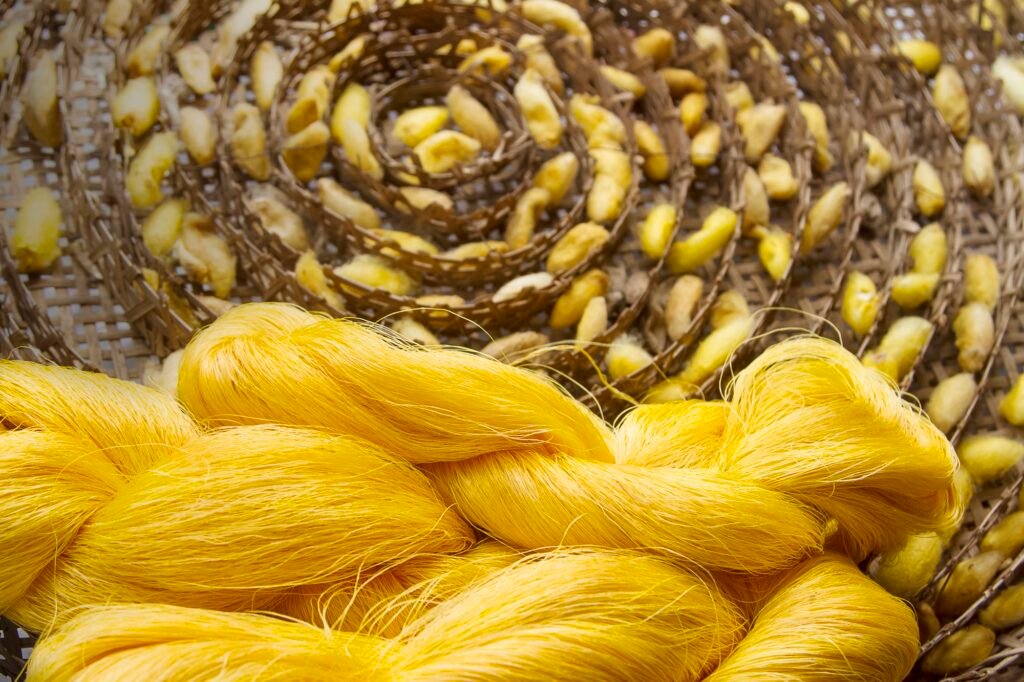
Silk is a fiber. It is a natural protein filament produced by the silkworm — specifically the larvae of the Bombyx mori moth — as it spins its cocoon. The silkworm feeds almost exclusively on mulberry leaves, and after weeks of eating, it begins to secrete a liquid protein from two glands near its head. This liquid hardens on contact with air into a single, continuous thread that can stretch for hundreds of meters, wound round and round into a tight, protective cocoon. Farmers harvest these cocoons, carefully unwind the thread in a process called reeling, and combine multiple filaments together to create the silk yarn that eventually gets woven into fabric.
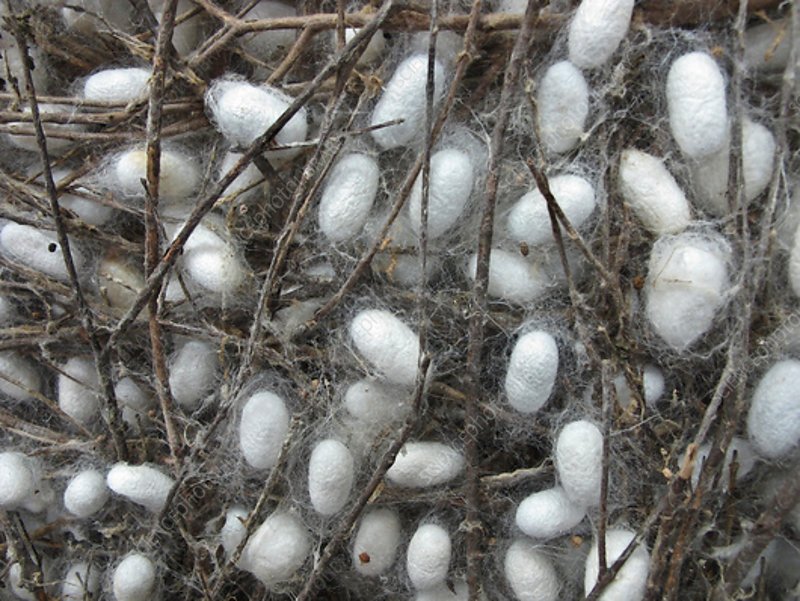
It’s an almost unbelievable process when you sit with it for a second — an insect literally manufactures one of the most prized textiles in human history, thread by thread, cocoon by cocoon. It takes somewhere around 2,500 to 3,000 cocoons just to produce a single pound of raw silk. That labor-intensive origin is a huge part of why real silk has always carried a premium price tag; it isn’t a marketing gimmick, it’s simply expensive to make.
Satin, on the other hand, is not a material at all. It is a method of weaving. In textile terms, there are really only three basic weave structures that everything else builds on: plain weave, twill weave, and satin weave. In a satin weave, the threads are constructed so that the “warp” threads (the ones running lengthwise) float over multiple “weft” threads (the ones running crosswise) before dipping under just one. This structure means very few interlacings show on the surface, which allows more light to reflect off the fabric’s face, giving satin its signature glossy, almost mirror-like sheen.
Here’s the part that trips everyone up: because satin is a weaving technique and not a fiber, you can make satin out of almost anything. Silk satin exists, and it’s genuinely luxurious — combining the natural fiber with the reflective weave gives you the fabric most people picture when they hear “satin sheets” or “satin gown.” But you can just as easily make satin from polyester, nylon, rayon, or acetate. Most satin sold today, especially in the affordable range, is made from polyester. It’s woven the same way silk satin is woven, so it has that similar shine and drape, but it is chemically and structurally an entirely different substance — essentially a plastic fiber derived from petroleum, extruded and spun into thread.
So when my aunt’s pillowcase said “silk” on the box but “polyester” on the label, what likely happened is that the manufacturer used the satin weave to mimic silk’s appearance, then let the word “silk” do some quiet, misleading work on the packaging, banking on the fact that most shoppers associate the shine with the fiber rather than the weave.
Where the Confusion Actually Comes From
It’s worth pausing to ask why this mix-up became so widespread in the first place, because it’s not purely accidental. Marketing has leaned into the ambiguity for decades. The word “satin” sounds expensive on its own. It has a certain old-world glamour to it, conjuring up images of Hollywood starlets in dressing gowns or Victorian ballgowns. Combine that with a shiny finish that visually resembles silk, and you have a perfect storm for confusion — especially in categories like bedding, lingerie, and eveningwear where shoppers are often making quick decisions based on how something looks in a photo rather than what it says in small print.
There’s also a simpler reason: for most of history, satin actually was made from silk. The satin weave was developed in China and takes its name from the port city of Quanzhou, historically known to European traders as “Zayton.” For centuries, if you owned satin, you almost certainly owned silk satin, because there weren’t yet synthetic fibers capable of imitating it. It’s only in the last hundred years or so, as synthetic textile production exploded following the invention of nylon in the 1930s and polyester a couple decades later, that “satin” started to mean something different from what it used to. The word stayed the same, frozen in its silk-era reputation, even as the material underneath it quietly changed.
This is really the crux of what I’d call “the synthetic trap.” Consumers are still operating on outdated assumptions, treating the word “satin” the way earlier generations did, as a near-synonym for silk. Meanwhile, manufacturers know this and, whether through clever wording or outright omission, let that outdated assumption work in their favor. A tag might say “satin,” and your brain fills in the rest with images of silkworms and mulberry trees, when the reality sitting in your shopping cart is a spool of polyester filament.
What It Actually Feels Like — And Why That Matters
Let’s talk about the sensory side of this, because that’s ultimately where the difference becomes impossible to ignore, even if you can’t pronounce the chemistry behind it.

Real silk has a few properties that no synthetic has ever fully replicated, no matter how advanced textile technology gets. The first is thermoregulation. Silk fibers are natural proteins, structurally similar in some ways to human hair and skin, and they have this uncanny ability to adjust to body temperature — they feel cool against hot skin in summer and retain a bit of warmth in cooler weather. This is why silk has been prized in bedding for centuries beyond its looks; it genuinely helps regulate sleep temperature.
Polyester, being a plastic derivative, does not breathe the same way. It’s hydrophobic, meaning it doesn’t absorb moisture well, so instead of wicking sweat or humidity away from your skin the way silk does, it tends to trap heat and moisture against the body. If you’ve ever slept on a hot night under synthetic sheets and woken up feeling clammy rather than fresh, that’s the difference showing up in real time.
The second big difference is friction, which matters enormously for anyone using these fabrics for hair or skin care. Silk fibers have an extremely smooth, almost triangular cross-section at a microscopic level, which reduces friction against hair strands and skin. This is the actual, physiological reason silk pillowcases are recommended for reducing hair breakage and minimizing those creased “sleep lines” that can form on your face overnight. Satin weave — regardless of fiber — does reduce friction somewhat compared to a plain weave, because of that long, smooth float of thread on the surface. So a polyester satin pillowcase will feel smoother than, say, a cotton one. But it still won’t match silk’s natural glide, and depending on the quality of the polyester, it can sometimes create a different kind of friction, a slight tackiness in humid conditions that pure silk doesn’t have.
There’s also the matter of weight and drape. Silk has a natural, fluid drape — the way it falls and moves is often described as “liquid,” which is why silk garments seem to flow rather than hang. Polyester satin can approximate this to varying degrees depending on how finely it’s woven and finished, but cheaper polyester satin tends to have a stiffer hand-feel, and it often makes a distinctive rustling or crinkling sound when you move it, which silk generally does not.
And then there’s the smell — an underrated giveaway. Burn a tiny thread of real silk (carefully, at the very edge of a scrap, the way jewelers test gold) and it smells like burning hair, because it is, biologically speaking, a protein just like hair and skin. It curls into a brittle, easily crushed ash. Burn a thread of polyester and it smells like melting plastic, and instead of turning into ash, it usually shrinks away from the flame and forms a hard little bead, because it’s melting rather than combusting the way organic material does. This burn test is actually one of the most reliable ways textile experts and quality inspectors distinguish real silk from synthetic satin when labels can’t be trusted.
The Price Tag Doesn't Lie (Usually)
If there’s one practical rule of thumb that tends to hold up, it’s this: pure silk is expensive to produce, and that cost inevitably shows up in the final price. A queen-size silk pillowcase made from good quality mulberry silk, measured in momme weight (a traditional unit measuring the density of silk fabric, generally the higher, the better, with 19 to 25 momme considered good for bedding), typically costs somewhere in the range of sixty to over a hundred dollars, sometimes more depending on the brand and momme count. A polyester satin pillowcase, by contrast, can often be found for under fifteen dollars.
That massive price gap isn’t arbitrary. It reflects the actual cost difference in raw materials and labor between farming silkworms, feeding them mulberry leaves for weeks, carefully reeling out their cocoons thread by thread, and the comparatively cheap, highly automated, petroleum-based process of extruding polyester filament. So when you see something marketed as “silk” or “silky” for a suspiciously low price, that price itself is often the biggest clue that you’re looking at satin-weave polyester rather than the real thing.
That said, price alone isn’t a perfect filter, because some brands do charge silk-level prices for satin — banking on the confusion to justify a markup that has nothing to do with actual material cost. This is really where reading labels carefully becomes non-negotiable. The tag should explicitly state the fiber content: “100% Mulberry Silk,” or “100% Silk,” if it’s the real thing. If it says “Satin,” “Silky-satin,” “Satin-weave polyester,” or simply doesn’t specify a fiber content at all while emphasizing the word “satin” prominently, that’s very likely a synthetic product, dressed in silk-adjacent language.
A Story From the Bridal Aisle
I think one of the clearest examples of how this confusion plays out happens in bridal shopping, an environment already emotionally charged enough without added confusion over fabric labels. A friend of mine, getting married a couple summers ago, told me about trying on gowns at three different bridal shops in a single afternoon. Two of the dresses were described by the sales associates as “silk satin,” and one was described simply as “satin.” When she asked directly whether they were made from real silk, only one associate could answer confidently — the other genuinely didn’t know, because to her, “satin” already implied luxury regardless of fiber content.
My friend ended up choosing the dress that was honestly labeled as polyester satin, not because it was fake or lesser in some absolute sense, but because it fit her budget and she liked how it moved under the reception lights. What stuck with her, though, was how close she came to overpaying for a “silk satin” dress that, upon closer inspection of the tag inside, turned out to also be polyester — just marketed with the word “silk” attached loosely to imply an authenticity that wasn’t there.
This story captures something important: satin isn’t inherently a bad or dishonest fabric. Polyester satin has real, legitimate uses — it’s more affordable, easier to care for, machine washable in most cases, resistant to wrinkling, and honestly gorgeous under the right lighting for occasions like bridesmaid dresses, prom gowns, or lining fabric. The problem isn’t the existence of polyester satin. The problem is when it’s marketed in a way designed to blur the line between itself and silk, letting customers assume they’re getting fiber-level luxury when they’re really getting a clever weave applied to a much cheaper material.
The Sustainability Layer Nobody Talks About
There’s another dimension to this conversation that rarely comes up in fabric-shopping guides: the environmental footprint of each material. Silk, being a natural, biodegradable protein fiber, breaks down in the environment far more readily than polyester. Polyester, derived from petroleum, is essentially a plastic, and like most plastics, it does not biodegrade on any meaningful human timescale. It also sheds microplastic fibers during washing, which enter waterways and, eventually, the ocean, contributing to a pollution problem researchers are still working to fully understand.
Silk production isn’t without its own ethical questions, though, particularly around the treatment of silkworms, since traditional silk reeling generally requires killing the pupae inside the cocoon before the moth emerges and damages the thread. This has led to the rise of alternatives like “peace silk” or “Ahimsa silk,” which allow the moth to emerge naturally before the cocoon is processed, though the resulting thread is typically shorter and the fabric less lustrous.
Polyester satin, meanwhile, sidesteps the animal welfare question entirely, since no insect life is involved, but trades it for the environmental cost of plastic production and slow decomposition. So depending on what a shopper values most, ethically or environmentally, the “better” choice between silk and synthetic satin isn’t a straightforward answer, and it’s part of why simply defaulting to “natural is always better” oversimplifies a genuinely complicated tradeoff.
Learning to Read Labels Like a Detective
By the time my aunt told me her story about the misleading pillowcase, I’d already had my own smaller version of the same experience, buying a scarf years earlier that was advertised online with a product photo showing it draped elegantly over a mannequin’s shoulder, captioned with the phrase “luxurious silky satin scarf.” I remember zooming into the product photos on my phone, scanning for a materials breakdown, and finding absolutely nothing until I scrolled deep into the reviews, where someone had photographed the actual tag: 100% polyester.
That experience taught me something simple but useful: read the materials section before you read the marketing copy. Product titles and descriptions are written by marketing teams whose job is to sell you on a feeling, and “silk” as a word carries an emotional weight that “polyester” simply doesn’t. But the materials or specifications section, usually required by law in most countries to be accurate, tells you what you’re actually buying. If a listing goes out of its way to describe something as “silky” or “silk-like” or “satin” without ever using the specific phrase “100% silk” or naming the type of silk (mulberry, tussar, eri, muga), that absence is often the answer in itself.
It also helps to know a few specific terms that manufacturers of genuine silk products tend to use, precisely because those terms don’t apply to synthetics. “Momme weight,” for instance, is a unit of measurement used almost exclusively for silk, describing the density of the fabric — you’ll rarely, if ever, see a polyester product listed with a momme count, because the measurement system was developed specifically around silk’s weight-to-area ratio. Similarly, terms like “charmeuse,” which technically refers to a lightweight silk satin with a dull back and glossy front, get borrowed loosely by synthetic manufacturers too, so even that term isn’t a guaranteed marker of authenticity on its own — but combined with an explicit fiber content statement, it can help confirm what you’re looking at.
Touch, when you have the chance to shop in person, remains one of the best tools available. Real silk has a very particular coolness when you first touch it, almost like touching a slightly chilled stone, whereas polyester tends to feel closer to room temperature or even slightly warm because it doesn’t conduct heat away from your skin the same way. Silk also has a subtle texture under the shine — a faint, almost grainy irregularity if you look closely, a natural imperfection that comes from being an organic fiber rather than an engineered one. Polyester’s surface tends to be more uniformly smooth and glassy, precisely because it’s manufactured to a consistent specification rather than grown by a living organism.
Bringing It Home
By the time I explained all this to my aunt, sitting at her kitchen table a few weeks after her pillowcase disappointment, she laughed and said she felt a bit silly for not knowing sooner. But I told her what I believe is actually true: this isn’t common knowledge because it isn’t meant to be. An entire section of the textile marketing world benefits from the confusion between satin and silk staying exactly where it is, comfortably fuzzy in the minds of shoppers. The moment people fully understand that satin is a weave and silk is a fiber, and that you can have one without the other, a lot of clever, ambiguous packaging loses its power.
She ended up returning the pillowcase and, after actually reading labels this time, bought a genuine mulberry silk one from a smaller manufacturer that listed its momme weight, country of silk origin, and fiber content clearly on the product page. It cost more than four times what she’d originally paid, but she told me a few nights later that she finally understood, physically, what all the fuss over silk had always been about — the temperature of it against her cheek, the way her hair didn’t catch and tangle against the pillow the way it usually did.
That’s really the heart of this whole story. Satin and silk aren’t rivals exactly, and one isn’t a scam version of the other in every case — polyester satin has honest, useful applications when it’s sold as what it is. The trap isn’t the existence of synthetic satin. The trap is the quiet, decades-old habit of letting the word “satin” borrow silk’s reputation without earning it, letting a weave pretend to be a fiber, and letting shoppers pay silk-level attention without necessarily getting silk-level material. Once you know to separate the weave from the thread, you stop falling for the shine and start reading the label — and that one small habit changes almost everything about how you shop for anything described as silky ever again.
ld up, it’s this: pure silk is expensive to produce, and that cost inevitably shows up in the final price. A queen-size silk pillowcase made from good quality mulberry silk, measured in momme weight (a traditional unit measuring the density of silk fabric, generally the higher, the better, with 19 to 25 momme considered good for bedding), typically costs somewhere in the range of sixty to over a hundred dollars, sometimes more depending on the brand and momme count. A polyester satin pillowcase, by contrast, can often be found for under fifteen dollars.
That massive price gap isn’t arbitrary. It reflects the actual cost difference in raw materials and labor between farming silkworms, feeding them mulberry leaves for weeks, carefully reeling out their cocoons thread by thread, and the comparatively cheap, highly automated, petroleum-based process of extruding polyester filament. So when you see something marketed as “silk” or “silky” for a suspiciously low price, that price itself is often the biggest clue that you’re looking at satin-weave polyester rather than the real thing.
That said, price alone isn’t a perfect filter, because some brands do charge silk-level prices for satin — banking on the confusion to justify a markup that has nothing to do with actual material cost. This is really where reading labels carefully becomes non-negotiable. The tag should explicitly state the fiber content: “100% Mulberry Silk,” or “100% Silk,” if it’s the real thing. If it says “Satin,” “Silky-satin,” “Satin-weave polyester,” or simply doesn’t specify a fiber content at all while emphasizing the word “satin” prominently, that’s very likely a synthetic product, dressed in silk-adjacent language.
FAQs
Is satin always fake silk?
No. Satin is just a weaving technique, and it can be made from real silk, in which case it’s genuinely luxurious. The issue only arises when polyester or another synthetic is woven into satin and marketed in a way that implies it’s silk.
How can I tell if something is real silk without a burn test?
Check the label for an explicit fiber content statement like “100% Mulberry Silk” and look for a momme weight, since that measurement is specific to silk. Real silk also feels cool to the touch and has a subtle, slightly irregular texture rather than a perfectly uniform shine.
Is polyester satin bad quality?
Not necessarily. It’s more affordable, easier to wash, and resists wrinkling, making it practical for many uses. It simply doesn’t offer silk’s natural breathability, hair-friendliness, or biodegradability, so it’s a different product with different strengths, not an inferior version of silk.