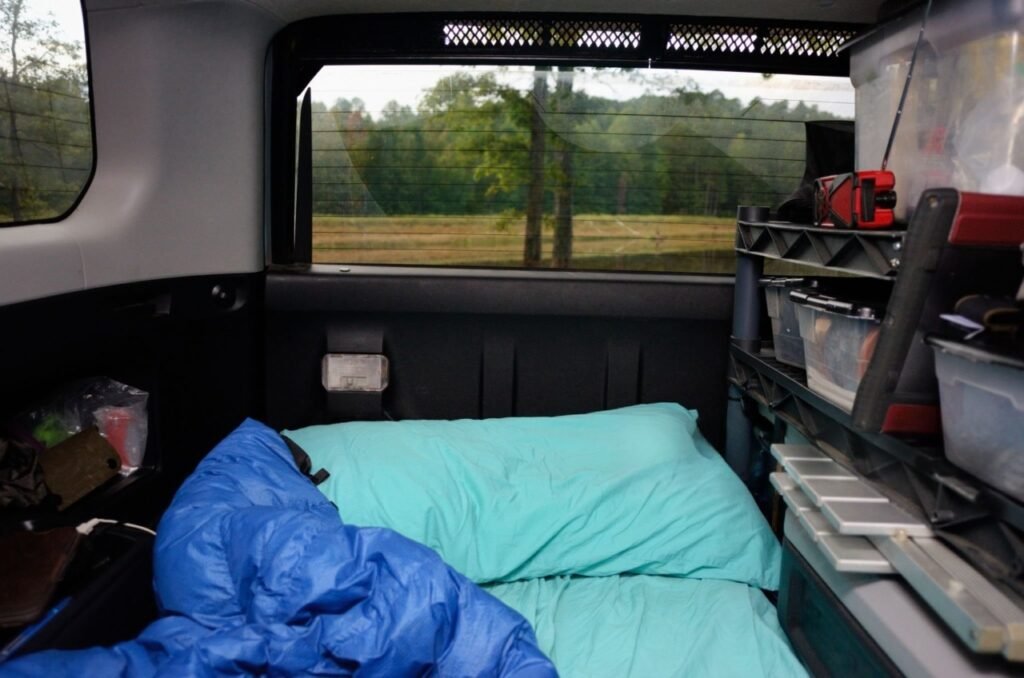
The first night we slept in the van, we thought we had won at life.
It was a crisp October evening in the mountains. We had spent six months converting a Ram Promaster van with our own hands—insulating walls, wiring lights, building cabinets out of birch plywood. The final piece, the one we had saved for last, was the bed. A fixed platform in the back, framed with 2x4s, topped with a custom-cut 6-inch memory foam mattress we had ordered online after measuring the space no fewer than seventeen times. We had waited weeks for that mattress to arrive. When it did, we unrolled it like a sacred scroll, watched it expand, and declared the build complete.
That night, we made the bed with the sheets we had brought from our old apartment. Standard queen-size flannel, soft from years of use, familiar. We tucked them in, smoothed the duvet, placed two pillows in matching shams. We lit a candle, opened a bottle of wine, and toasted to the open road. This was it. Freedom. Minimalism. Life untethered.
I woke up at 2:47 a.m. tangled in a nest of cotton that resembled a failed parachute.
The sheets had migrated. Not just a little—they had staged a full-scale geographical relocation. The fitted sheet had peeled off one entire corner and was bunched in a heap at the foot of the bed. The flat sheet was wrapped around my legs like a constrictor snake. My partner, somehow, had managed to retain her half of the bedding and was sleeping peacefully, a duvet-wrapped island of calm while I drowned in fabric chaos.
I lay there in the dark, the cold night air seeping through the van’s windows, and realized something profound: I had no idea what I was doing.
You see, I came to van life with a lifetime of assumptions about bedding. Assumptions forged in the world of stationary houses, standard mattress sizes, and beds that don’t move. I thought a sheet was a sheet. I thought a queen was a queen. I thought if you had a mattress, you put sheets on it, and that was the end of the story.
The van laughed at my assumptions. The van laughed, and then it hit a pothole.
Our first mistake was assuming our custom mattress was anything close to a standard size. It wasn’t. We had measured the bed platform to maximize every inch of space in the van. The platform was 74 inches long and 52 inches wide—a size that exists nowhere in the bedding industry. Too long for a full, too narrow for a queen. It was an orphan. A beautiful, memory-foam orphan that no sheet in any big-box store would ever love.
I learned this the hard way during a frantic stop at a Target in Flagstaff, Arizona, three days into our first road trip. We had been sleeping on bare mattress for two nights because the flannel sheets from home had proven unusable. I walked into the bedding aisle with the confidence of a man who had bought sheets before. I left with three different sizes—full, queen, and something labeled “RV queen”—a confused receipt, and a growing sense that I had underestimated this challenge.
Back at the van, parked in a Cracker Barrel lot, I opened the packages and began the experiment. The full sheets went on first. They fit across the width but left a six-inch gap at the foot of the mattress, like a shirt that was too short. The queen sheets fit the length but pooled massively on the sides, creating fabric oceans that would inevitably drown me by morning. The RV queen was closer—it was designed for the slightly narrower, slightly shorter mattresses common in RVs—but it still bagged on the sides.
I sat on the tailgate of the van, surrounded by crumpled sheets, and felt like I was failing at a very simple task. It’s just bedding, I told myself. People have been putting sheets on beds for centuries. Why was this so hard?
The answer, I would come to understand, is that van life and RV living exist in a strange middle ground. You’re not using a standard mattress. You’re not in a standard space. And the bedding industry, for the most part, has not caught up to the tiny home revolution. You have to get creative. You have to stop thinking like a person in a house and start thinking like a person who lives in a vehicle.

That night in Flagstaff, I did what any modern person does when confronted with a problem: I went down an internet rabbit hole at 11 p.m. on my phone.
I learned about the world of RV bedding, which is its own strange universe. I discovered that “RV queen” is not a myth—it’s a real size, typically 60 inches wide by 75 inches long, compared to a standard queen which is 60 by 80. That five-inch difference matters. I learned there is also “RV king” (72 by 75) and “short queen” and “Olympic queen” and a dozen other variations that seem designed to confuse the average consumer.
But more importantly, I learned that van lifers and RV dwellers had been solving this problem for years, and their solutions were elegant in their simplicity. They didn’t try to force standard sheets onto non-standard mattresses. They worked with the space instead of against it.
One solution kept appearing across forums and blogs: make your own sheets, or have them made. Find a local seamstress, buy high-quality cotton or bamboo fabric, and create fitted sheets that match your exact mattress dimensions. It sounded intimidating at first—I had never sewn anything more complicated than a button—but the logic was undeniable. A custom sheet made for a custom mattress would fit perfectly, with no bagging, no pulling, no midnight escapes.
I found a woman on Etsy who specialized in custom RV bedding. Her name was Linda, and her shop was called “Tiny Home Textiles.” I sent her our mattress measurements—74 by 52, with a depth of 6 inches—and she quoted me a price that was actually less than the high-end sheets I had bought at department stores. Two weeks later, a package arrived at our mail forwarding service in South Dakota. Inside were two fitted sheets in a soft grey linen blend, each with deep pockets and full-perimeter elastic, sewn to the exact dimensions of our van mattress.
The first time I put one on, I nearly cried. It fit like a glove. No slack, no straining, no corners popping off. The elastic hugged the mattress evenly, and the fabric sat flush against the surface. It was such a small thing, but it felt like a revolution.
That fitted sheet became the foundation of our van bedding system. Everything else—the flat sheet, the blankets, the duvet—was built on top of it. And because the fitted sheet was custom, it never moved. We drove over mountain passes, through desert washboard roads, across the winding highways of the Pacific Coast, and that sheet stayed put.
But the fitted sheet was only the beginning. I quickly learned that bedding in a small space requires a different philosophy than bedding in a house. In a house, you can have multiple sets of sheets, extra blankets, decorative pillows, a heavy duvet for winter and a light quilt for summer. You have closets. You have linen cabinets. You have space.
In a van, you have none of those things.
Our van has exactly two storage compartments that can hold bedding: a small cubby under the bed platform and a narrow cabinet above the driver’s cab. That’s it. Every piece of bedding we carry must justify its existence in cubic inches.
This forced me to think differently about what we actually needed versus what we had been conditioned to think we needed. Did we need a flat sheet, or could we do without? Did we need separate summer and winter duvets, or could we find a single solution that worked across seasons? Did we need four pillows, or could we make do with two?
The answers, I found, were surprisingly liberating.
We ditched the flat sheet entirely. In a house, a flat sheet serves as a barrier between you and the duvet, making it easier to wash just the sheet instead of the whole comforter. In a van, we were washing our duvet cover regularly anyway because space is tight and things get dirty faster. The flat sheet was just one more thing to fold, one more thing to wrestle with in the night, one more thing taking up precious storage space. We let it go, and we never missed it.
We replaced our heavy winter duvet and light summer quilt with a single all-season down comforter that we could layer with blankets as needed. In cold weather, we added a wool blanket underneath the duvet. In warm weather, we used just the duvet cover with no insert. One duvet cover, one insert, one wool blanket. That was it. Everything fit in a single storage cube under the bed.
And pillows. Oh, the pillows. We had started with four—two for sleeping, two decorative shams that we thought made the van look “cozy” for Instagram photos. Within a month, the shams were relegated to a storage unit we rented in Tucson. They looked nice but served no functional purpose, and in a 70-square-foot living space, functional purpose is everything. We kept two sleeping pillows, each with a washable cover, and that was enough.

One of the biggest surprises in our bedding journey was learning to embrace unconventional materials.
In a house, your bedding is chosen for comfort and aesthetics. In a van, it also needs to handle moisture, temperature swings, and constant movement.
Our first winter in the van, we woke up to condensation dripping from the ceiling windows. The van’s interior, warm from our breath and body heat, met the cold metal walls and created moisture. That moisture settled on everything, including our bedding. Our cotton sheets would feel damp in the morning—not wet, but that clammy, unpleasant dampness that makes you want to crawl out of bed immediately.
I learned that cotton, for all its virtues, is not ideal for van life. It absorbs moisture readily and takes a long time to dry. In a humid environment or a cold climate, cotton bedding becomes a moisture sponge, leading to that damp feeling and, in extreme cases, mildew.
The solution was merino wool and bamboo.
We bought a merino wool blanket—the kind used by backpackers and thru-hikers—and started using it as our base layer. Merino is naturally moisture-wicking, antimicrobial, and temperature-regulating. It kept us warm on cold nights without trapping sweat, and it dried quickly if it got damp. It was also surprisingly lightweight and packed down small.
For our duvet cover, we switched from cotton to bamboo lyocell. Bamboo fabric is softer than cotton, breathes better, and is naturally moisture-wicking. It also has antimicrobial properties, which is a fancy way of saying it doesn’t get funky as fast. In a small space where you’re living close to your bedding, that matters.
These materials cost more upfront than standard cotton sheets. I won’t pretend they didn’t. But they have lasted twice as long as our previous bedding, handled the unique demands of vehicle life, and kept us comfortable through desert heat and mountain cold. When you live in a van, you learn that investing in quality materials that do one thing exceptionally well is better than accumulating multiple cheap things that do a mediocre job.
Another lesson came from observing how we actually used the bed in the van versus how we had used a bed in a house.
In our apartment, the bed was for sleeping. That was it. We got in at night, got out in the morning, and maybe lounged on it for a lazy Sunday now and then.
In the van, the bed is everything. It’s where we sleep, yes, but it’s also our couch, our dining nook, our workspace, our storage platform, and sometimes our makeshift table when we’re too lazy to set up the camp table outside. We sit on it to read. We eat breakfast on it when it’s raining. We fold laundry on it. We use it as a staging area for packing and unpacking.
This meant our bedding needed to be functional in ways we had never considered. It needed to transition easily from sleep mode to day mode. It needed to stay clean even when we were eating on it. It needed to be quick to make and quick to unmake.
Our solution came in the form of a modular bedding system.
We started with the custom fitted sheet as our base. On top of that, we added a thin quilt—not for warmth, but as a protective layer. During the day, we folded the quilt and stored it in a fabric bin, leaving the fitted sheet exposed. The fitted sheet was easy to wipe down if it got crumbs or dirt, and because it was dark grey, it didn’t show every speck of dust.
At night, we unrolled the quilt, added the wool blanket and duvet as needed, and made up the bed. In the morning, we stripped off everything except the fitted sheet, folded the bedding into a neat stack, and placed it in the storage cubby. The whole process took less than two minutes.
We also learned to love bedding that didn’t require ironing. In a van, you don’t have an iron. You don’t have an ironing board. You barely have a flat surface larger than a cutting board. If your sheets wrinkle, they stay wrinkled until you wash them. We chose fabrics—bamboo, linen, merino—that look good with natural wrinkles and don’t require fussing.

Perhaps the most unexpected challenge came from the fact that the van moves.
This sounds obvious, I know. Vans move. That’s the whole point. But I had not fully considered what constant motion would do to my bedding until I woke up one morning in a Utah campground with my pillow on the opposite side of the van from where I had placed it, my duvet half on the floor, and my partner somehow rotated ninety degrees relative to the mattress.
The van had been level when we parked. Sometime in the night, we had shifted, and the bedding had shifted with us. It was like sleeping on a gently moving platform that never quite settled.
I started paying attention to the physics of bedding in a moving vehicle. Standard sheets, with their slick cotton surfaces, allow for sliding. Pillows slide. Duvets slide. People slide. In a house, this doesn’t matter because nothing is moving. In a van, every turn, every incline, every acceleration and deceleration creates forces that work against your bedding staying put.
The solution came in three parts.
First, we added a mattress topper with a non-slip backing. There are dozens of these on the market—thin pads with rubberized bottoms that grip the mattress surface. We placed this between the mattress and the fitted sheet, and suddenly the fitted sheet had something to grip. No more sliding.
Second, we switched to bedding with texture. Our bamboo duvet cover had a slight sateen finish that was beautiful but slippery. We replaced it with a linen blend that had more grip. The wool blanket, naturally textured, also helped create friction that kept layers from shifting.
Third, we embraced the beauty of the sleeping bag concept for really rough conditions. On nights when we knew we would be driving late and parking on uneven ground, we simply unzipped our sleeping bags—the same ones we used for backpacking—and used those instead of traditional bedding. They kept us warm, they didn’t shift, and they were designed for the exact conditions we were facing. It felt less elegant than a made bed with a duvet, but sometimes function wins over form.
The final evolution in our bedding philosophy came when we realized that the van itself was part of the system.
In a house, the bedroom is climate-controlled. You set the thermostat, and the room stays a consistent temperature. In a van, you are at the mercy of the elements. A sunny afternoon can turn a van into an oven. A cold night can make it a refrigerator. Your bedding needs to work with the van’s systems, not against them.
We installed a MaxxAir fan in the roof for ventilation, and we learned to use it strategically. On warm nights, we would open the fan and a window, creating cross-breezes that pulled heat out of the van. On cold nights, we would close everything up and rely on our propane heater—but we learned not to run the heater all night, both for safety and to conserve propane. Instead, we heated the van before bed, then relied on our layered bedding to retain warmth through the night.
We also learned about the power of thermal curtains. The van’s windows, even with double-pane glass, are weak points in the thermal envelope. We made insulated window covers out of Reflectix and black fabric, and we put them up every night. They kept heat in during winter, kept heat out during summer, and had the added benefit of blocking light so we could sleep past sunrise.
These covers became part of our bedding routine. At night, after making the bed, we would pop the covers into the windows. In the morning, we would take them down and stow them behind the driver’s seat. It added maybe three minutes to our nightly and morning routines, but the difference in comfort was enormous.

Now, two years into van life, I have become something of an accidental expert on bedding for small spaces. Fellow van dwellers ask me what we use. Friends who are building out RVs call me for advice. I have opinions about thread count (lower is often better for durability), fabric blends (avoid pure cotton), and pillow fill (down packs smaller than synthetic, but synthetic handles moisture better).
But more than the specific products, I have developed a philosophy about bedding in a small space. It can be summed up in three principles that I learned the hard way on that first cold night in Flagstaff.
The first principle is that custom beats standard. If you have a non-standard mattress—and if you’re living in a van or RV, you almost certainly do—stop trying to force standard sheets to work. Get a custom fitted sheet made for your exact dimensions. It costs more upfront, but it will last longer and perform better than anything you buy off the shelf. Linda from Tiny Home Textiles is still making our sheets, and I will sing her praises to anyone who asks.
The second principle is that less is more. In a small space, every item you bring must earn its keep. Do you really need a flat sheet? Do you really need four pillows? Do you really need separate bedding for different seasons? Question every assumption you brought from house living. Pare down until you have only what you actually use. You will sleep better with less clutter around you.
The third principle is that materials matter. Cotton is comfortable, but it doesn’t handle moisture well in a vehicle environment. Bamboo, linen, merino wool, and technical fabrics designed for outdoor use often perform better. Don’t be afraid to look outside the traditional bedding aisle. Some of our best bedding choices came from outdoor gear companies, not home goods stores.
The other night, we were parked on BLM land outside Moab, Utah. The red rock desert stretched out around us, and the stars were so bright they cast shadows. We made the bed in the van—custom fitted sheet, wool blanket, bamboo duvet cover with the down insert, two pillows in linen shams. It took three minutes.
We sat in the open side doors with cups of tea, looking out at the desert. The van was warm from the heater we had run for an hour. Our bedding was waiting, ready, a small sanctuary of softness in a landscape of stone and dust.
Later, when we crawled into bed, I noticed that nothing shifted when I moved. The fitted sheet stayed put. The duvet stayed centered. The pillows stayed where I placed them. I lay there in the dark, listening to the quiet, and thought about that first night in the van, tangled in flannel sheets that didn’t fit, cold air creeping in, feeling like I had made a terrible mistake.
We had come a long way since then. Not just in bedding, but in understanding how to live well in a small space. The bedding had been a teacher, in its way. It had forced me to let go of assumptions, to solve problems creatively, to value function over form without sacrificing comfort.
I fell asleep to the sound of wind against the van’s roof, and I did not wake until sunrise.
If you’re reading this and you’re just starting your own van or RV journey, or maybe you’re already in the thick of it, wrestling with sheets that won’t stay on and duvets that take up too much space, here is what I want you to know: it gets easier.
The bedding challenges of small-space living are solvable. They might take some trial and error. You might buy the wrong sheets once or twice. You might discover that the beautiful linen duvet cover you loved in your apartment is a nightmare in a van. That’s okay. That’s how you learn.
Start with your mattress. Measure it carefully. Get a custom fitted sheet if you can. If that’s not in your budget, look for RV-specific sizes and be prepared to tuck and clip. Full-perimeter elastic is your friend. Sheet suspenders are not defeat—they’re strategy.
Think about your materials. Consider moisture management. Consider how your bedding will handle temperature swings. Consider how it will pack down when you need to reclaim your bed for daytime activities.
And remember that you are not alone. There is a whole community of van dwellers, RVers, and tiny home residents who have wrestled with these same questions. They are on forums, in Facebook groups, at campgrounds. They have solved problems you haven’t even encountered yet. Ask them. Learn from their mistakes so you don’t have to make them yourself.
We are still learning. Every season brings new challenges. We are currently figuring out how to keep bedding fresh when we spend weeks in the humid Pacific Northwest. We are experimenting with wool-filled duvets for better moisture management. The journey never really ends, and that’s part of what makes this life interesting.
But the foundation is solid. The custom fitted sheet fits like it was made for us, because it was. The bedding system works for the way we actually live, not the way we imagined we would live when we were still dreaming about van life from our apartment couch. We have found what works for us.
You will find what works for you.
And when you do, on some night in some beautiful place, you will crawl into a bed that feels like home, even though home moves with you. You will sleep deeply. You will wake up ready for the road.
And you will not wake up tangled in a nest of cotton that resembles a failed parachute.
Trust me on this one. I learned the hard way so you don’t have to.