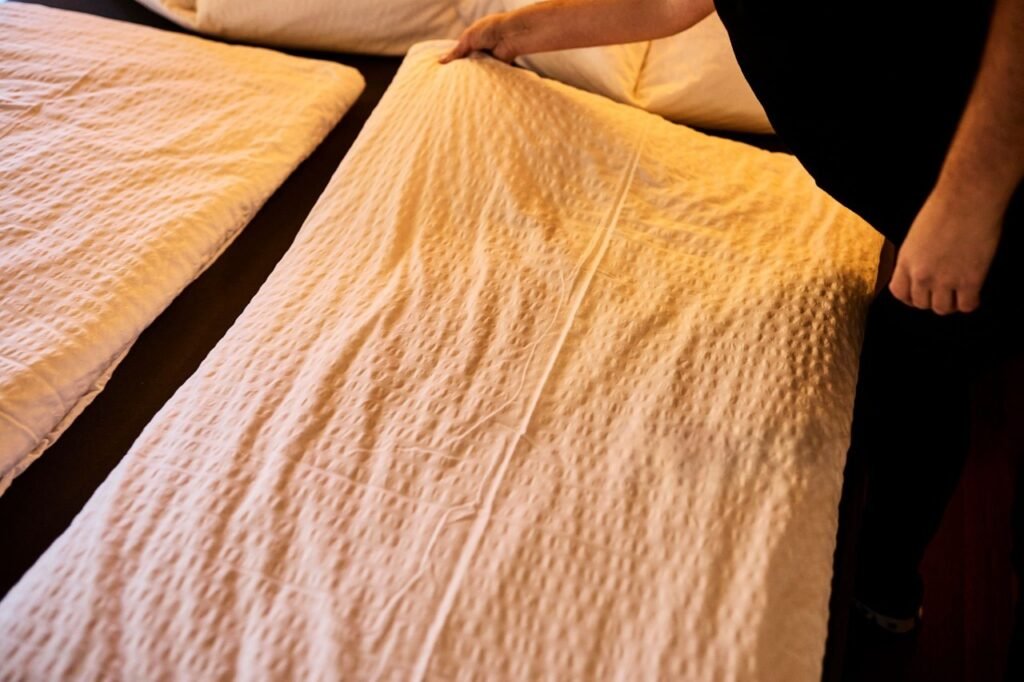
It starts as a subtle annoyance. A slight bunching of fabric under your hip. A cool spot on your leg where the bare mattress meets your skin. Then comes the realization, that groggy, 3:00 AM consciousness that pulls you from a perfectly good dream: it has happened again. The fitted sheet has surrendered. It has popped off the corner and retreated into a tangled wad at the foot of the bed, leaving you lying on a bare, crinkly mattress protector.
If you have ever woken up in a battlefield of linen, wrestling with a corner that simply refuses to stay put, you know the unique frustration of the great sheet escape. It is a domestic drama that plays out in bedrooms across the world every single night. We blame the sheets, we blame our restless sleep, and we blame the dog for digging at the blankets. But the truth, as I discovered after years of failed tucking and hundreds of dollars spent on bedding that promised the world and delivered a tangled mess, is far simpler. It usually comes down to one thing: size.
This is the story of how I finally made peace with my fitted sheet. It’s a journey into the surprisingly complex world of mattress dimensions, pocket depths, and elastic engineering. If you are tired of the nightly re-tucking ritual, pull up a duvet and let me tell you what I learned.
Chapter 1: A Tale of Two Mattresses (And Why My Sheets Quit)
My problem started, as these things often do, with an upgrade. We finally decided to replace our old, flat, decade-old mattress with a glorious, 14-inch deep pillow-top model. It was like trading a park bench for a cloud. The first night, I sank into it with a sigh of pure contentment. The second night, I woke up with my feet tangled in a nest of fabric.
Our old sheets, which had fit our previous mattress like a glove, were utterly defeated by the new one. They were the right length and width—they said “Queen” on the tag, and the mattress was a queen—but they might as well have been a tablecloth draped over a boulder. The corners would barely reach the underside of the mattress, clinging on by a mere inch of elastic. The slightest movement was all it took. The sheet would stretch taut, lose its grip, and sproing—freedom.
I stood in the linen aisle a few days later, staring at a wall of color-coded packages, feeling utterly defeated. They all said “Queen.” They all looked soft. How was I supposed to know which one would actually stay? That’s when I realized that buying a sheet isn’t about just buying a bed size; it’s about buying for your specific mattress. It’s about understanding the difference between the size on the box and the reality of what’s in your bedroom.
Chapter 2: The Confession: We’ve All Been Measuring Wrong
The first step to solving any problem is admitting you have one. And the problem was that I, like so many others, was a measuring minimalist. I knew my bed was a “queen,” so I bought “queen” sheets. End of story.
But a mattress, like a person, has more than just a width and a length. It has depth. It has personality in the form of pillow tops and memory foam layers. And if you ignore that depth, you are inviting the pop-off.
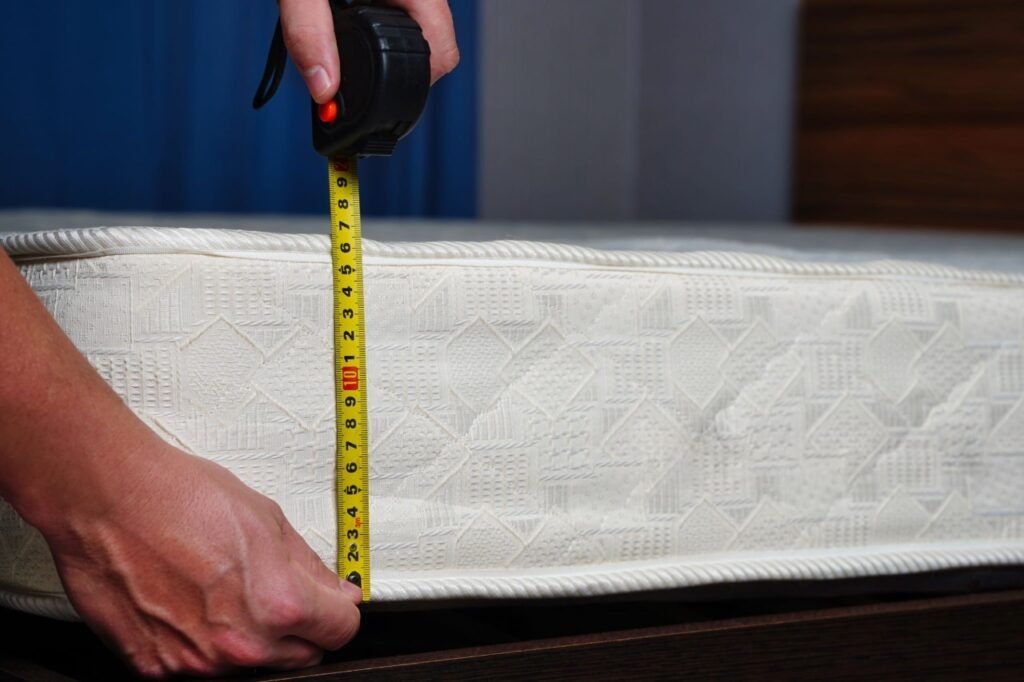
I went home and did something I had never done before. I pulled out a tape measure. My beautiful new mattress wasn’t just a queen; it was a tall, proud 14 inches from the base to the top of its plush pillow-top. I then looked at the tag on our old, failing fitted sheet. Its pocket depth—that little seam at the corner that creates the “cup” for the mattress—was a mere 12 inches.
It was a revelation. I was essentially trying to put a child’s sock on an adult’s foot. The sheet was doomed from the start .
This, I learned, is the cardinal rule of fitted sheet shopping. You must know the height of your mattress. Not just the type, not just the width, but the total height. This includes any mattress toppers or thick protectors you use. A two-inch memory foam topper turns a 12-inch mattress into a 14-inch beast. If you don’t account for that extra girth, your sheet doesn’t stand a chance .
Chapter 3: Decoding the Box: A Field Guide to Pocket Depth
Armed with my new knowledge, I returned to the store, tape measure still figuratively in hand. The packaging, which once looked like a uniform sea of “Queen,” suddenly revealed its secrets. I started flipping boxes over, reading the fine print. This is what I discovered about the secret language of sheets.
The industry, I realized, categorizes sheets not just by mattress size, but by the depth they are built to accommodate.
First, there are Standard Depth sheets. These are the entry-level players, usually designed for mattresses up to about 10 to 12 inches tall. They are perfect for guest rooms, kids’ beds, or older, thinner mattresses. But for my plush new cloud? They were useless .
Then, there are the knights in shining armor: Deep Pocket sheets. These are built for the modern mattress, usually fitting depths of 14 to 15 inches. This, I thought, was my answer. And for many, it is. But as I would later learn, the world of deep pockets has its own tiers.
Finally, for those who sleep on the truly monumental mattresses—the 16 to 22-inch hybrids and pillow-top behemoths—there are Extra Deep Pocket sheets. Some brands even go up to 21 or 22 inches to accommodate the growing trend of taller and taller beds .
I bought a beautiful set of deep-pocket queen sheets, 15-inch pocket depth, for my 14-inch mattress. I brought them home with the hope of a weary traveler. I fitted them onto the mattress, and for the first time in weeks, the corners tucked neatly and securely underneath. There was no straining, no stretching. It was a perfect fit.
Chapter 4: The Anatomy of a Sheet That Fights Back
That night, I slept like a log. The sheet held. I woke up in the morning to a bed that still looked made. It was a small victory, but it felt monumental. However, I soon learned that depth was only part of the equation. A few weeks and a few wash cycles later, I noticed the corners starting to feel a little… loose.
This led me to my second major discovery: the elastic.
All fitted sheets are not created equal in the elastic department. Many budget-friendly sheets, I found, have elastic only at the corners. This creates four points of grip, but the sides themselves have no tension. Over time, and with the heat of the dryer, that corner elastic can lose its snap, becoming limp and brittle. This is a primary cause of the dreaded pop-off .
The real champions, the sheets that truly fight back, feature what is often called 360-degree elastic. This means a heavy-duty elastic band is sewn all the way around the entire hem of the sheet. It hugs the perimeter of the mattress like a firm embrace, creating a tailored, secure seal that doesn’t rely solely on the corners .
I also learned about innovations like silicone grippers. Some high-end sheets, like those from DreamFit, embed small silicone strips in the elastic bands at the corners. This adds a level of friction that grips the fabric of the mattress or protector, preventing any shifting or creeping, especially on adjustable beds .
Chapter 5: The Unsung Hero: Your Mattress Protector
Just when I thought I had it all figured out, a new variable entered the chat: the mattress protector. In my quest for sheet domination, I had forgotten about the layer underneath.
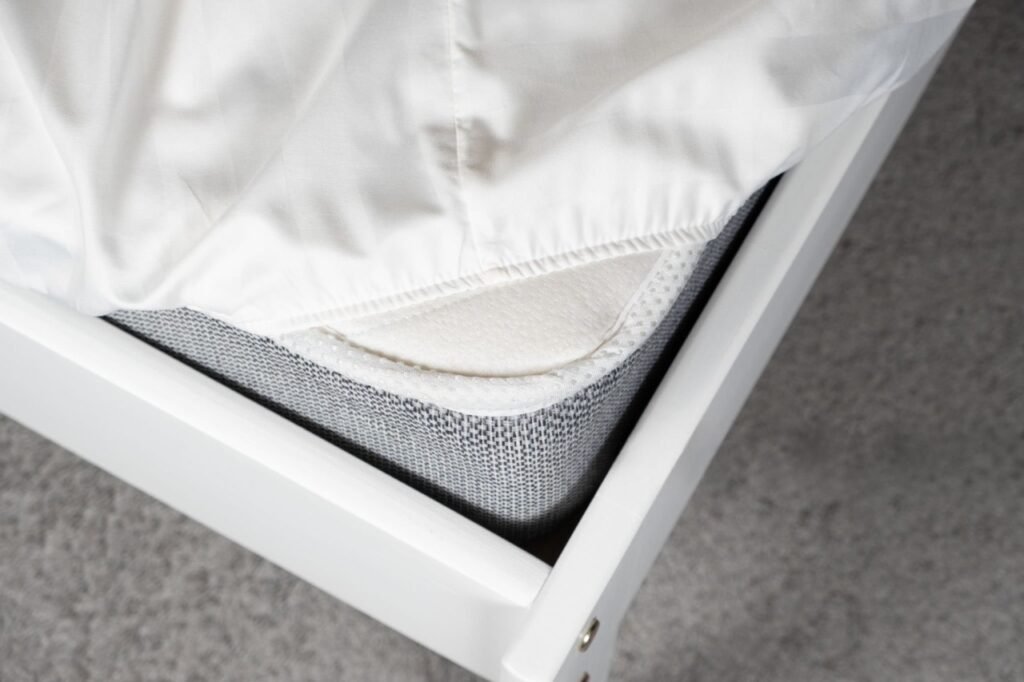
I had purchased a new, waterproof mattress protector to keep my investment safe. It was slick. It was smooth. And it was essentially a slip-and-slide for my fitted sheet. No matter how tight the sheet was, the protector’s surface offered zero friction, allowing the sheet to shift and bunch as I moved .
The fix was simple once I identified the problem. I swapped my slick protector for one with a quilted cotton top or a terry-cloth surface. This added a texture that grabbed the fitted sheet and held it in place. If you’re dealing with a slippery sheet situation, take a hard look at what’s underneath it. A flat cotton sheet placed between the mattress and the fitted sheet can also add enough friction to stop the slide .
Chapter 6: A Toolkit for the Truly Desperate (And the Restless Sleeper)
But what about those situations where you’ve done everything right? You’ve measured your mattress, bought the correct deep-pocket sheet with 360-degree elastic, and you have a grippy mattress protector. Yet, you or your partner are such active sleepers—tossing, turning, and doing nightly gymnastics—that the sheets still wage a war of attrition. For you, the truly desperate, there is a wonderful world of accessories designed to enforce a state of martial law on your bedding.
My favorite discovery is the sheet suspender or sheet strap. These ingenious little devices are essentially heavy-duty elastic straps with clips on each end. You attach them to the edges of your fitted sheet, run them diagonally under the mattress, and clip them on the other side. They act as a suspension bridge, pulling the sheet tight from underneath and making it virtually impossible for the corners to pop up. They are a cheap, effective, and completely invisible solution .
For those who want an even more permanent solution, there are zippered sheets. These are a two-part system: a base layer with a zipper around the edge that fits over the mattress, and a top sheet that zips onto it. Once it’s on, it’s on. It won’t move until you unzip it. It’s a bit more of an investment, but for adjustable beds or for people who simply cannot keep sheets in place, it is the nuclear option, and it is glorious .
I’ve even heard of people using Velcro strips, rug corners, and the same tape athletes use to keep their socks up. Where there’s a will, there’s a way .
Chapter 7: The Fabric of a Good Night’s Sleep
Throughout this journey, I also became attuned to how different fabrics behave. A sheet’s weave can be its best friend or its worst enemy in the fight against slippage.
Smooth, lustrous fabrics like satin, silk, or high-thread-count sateen feel divine against the skin. But they are, by their very nature, slippery. They lack the natural friction needed to grip the mattress. If you are a hot, restless sleeper who loves the feel of luxury, these fabrics might require a little extra help from sheet straps .
On the other hand, a fabric like cotton percale is a grippy overachiever. Percale has a crisp, matte finish created by a simple one-over-one-under weave. It’s breathable, cool, and has a texture that naturally clings to the surface beneath it. It’s the fabric equivalent of a good, firm handshake .
Linen, with its textured, slightly rough-hewn feel, also offers excellent grip. And for winter, flannel or brushed cotton is the ultimate in friction, clinging to mattress protectors like a cozy koala .
Chapter 8: A Brief Aside on Global Sizing
Just when you think you’ve mastered the art, it’s worth remembering that, like languages and driving laws, bed sizes aren’t universal. A UK article on the subject will have you reaching for your passport.
The measurements for a UK single, double, king, and super king are different from their US counterparts. For instance, a UK king-size mattress (150 x 200 cm) is actually closer in dimensions to a US queen. And what Americans call a king, the Brits might call a super king .
If you ever find yourself buying sheets online from another country, this is a crucial piece of information. Always, always check the centimeter or inch measurements on the package, not just the name of the size.

Conclusion: A Fitted Sheet Manifesto
My quest for the perfect fitted sheet took me from ignorance to obsession, from frustration to fascination. It taught me that a good night’s sleep is built on a foundation of details we often overlook.
The fitted sheet is the unsung hero of the bedroom. It is the foundation upon which we build our cozy nests. And when it fails, the whole structure collapses into chaos. But when it fits—truly fits, with the right depth, the right elastic, and the right fabric—it is a quiet miracle. It provides a smooth, tranquil surface that asks nothing of us and gives everything.
So, here is my fitted sheet manifesto, hard-earned through years of midnight wrestling matches:
- Measure thy mattress. Know its length, width, and most importantly, its depth. Account for toppers. Write it down. Keep it in your phone. This is your sacred text .
- Read the fine print. Do not be seduced by color or thread count alone. Seek out the “pocket depth” on the package. It should be at least two inches deeper than your mattress .
- Seek the 360. Look for elastic that runs the full perimeter of the sheet. It is the hallmark of a sheet built to last .
- Befriend your protector. Ensure the layer between your mattress and sheet is a friend, not a foe. Choose texture over slickness .
- Know thy fabrics. Understand that smoothness can come at the cost of grip. Be prepared to adapt .
May your corners stay tucked, your sleep be deep, and your 3:00 AM self never again be woken by the cold touch of a bare mattress. The great sheet escape can be stopped, and it starts with you.
FAQs
Q1: My sheets fit perfectly when I first put them on, but after washing them, they shrink and pop off. What am I doing wrong?
You’re likely not doing anything wrong; you’re just witnessing the natural shrinkage of natural fibers, especially cotton. This is incredibly common. Here’s the fix:
First, always check the care label. Wash sheets in cool or warm water, never hot, and tumble dry on low heat. High heat is the primary culprit of dramatic shrinkage. Remove them from the dryer while they are still slightly damp and put them on the bed immediately. The slight tension of being stretched over the mattress will help them finish drying in place and relax back to their original size. If they’ve already shrunk, you can try ironing them while slightly damp to stretch them back out, or consider buying sheets labeled “pre-shrunk” to minimize this issue in the future.
Q2: I have an adjustable bed that bends at the head and foot. Regular sheets just won't stay on. What kind of sheets do I need?
Adjustable beds are a whole different beast. Standard fitted sheets are designed for a flat, static surface and cannot accommodate the bending and movement. You need sheets specifically designed for adjustable bases.
Look for sheets that explicitly say they are “adjustable bed friendly.” These typically have a few key features:
Extra Deep Pockets: To accommodate the mattress thickness and the movement.
High-Tech Elastic: Often a stronger, more flexible elastic that can stretch and contract with the bed’s movements without losing its grip.
Silicone Grippers: As mentioned earlier, these are crucial for preventing the sheet from sliding on the mattress surface as the bed articulates.
Some people with adjustable beds also swear by the zippered sheet systems mentioned in Chapter 6, as they provide a completely secure, movement-proof fit.
Q3: Is thread count the most important factor in a good fitted sheet?
Absolutely not! This is one of the biggest myths in the bedding industry. Thread count simply refers to the number of horizontal and vertical threads per square inch. While a very low thread count (under 200) can feel rough, an extremely high thread count (over 800) is often achieved by using multi-ply, twisted threads, which can actually make the sheet feel heavy, less breathable, and more prone to pilling.
A far better indicator of quality is the type of cotton and the weave. Long-staple cotton (like Egyptian or Supima) creates stronger, finer threads and softer fabric. The weave determines the feel: percale is crisp, cool, and matte, while sateen is smooth, lustrous, and drapes well. Focus on finding a sheet made from high-quality cotton with a weave you like, in the 300-500 thread count range, and you will likely have a much better experience than chasing an astronomically high number.