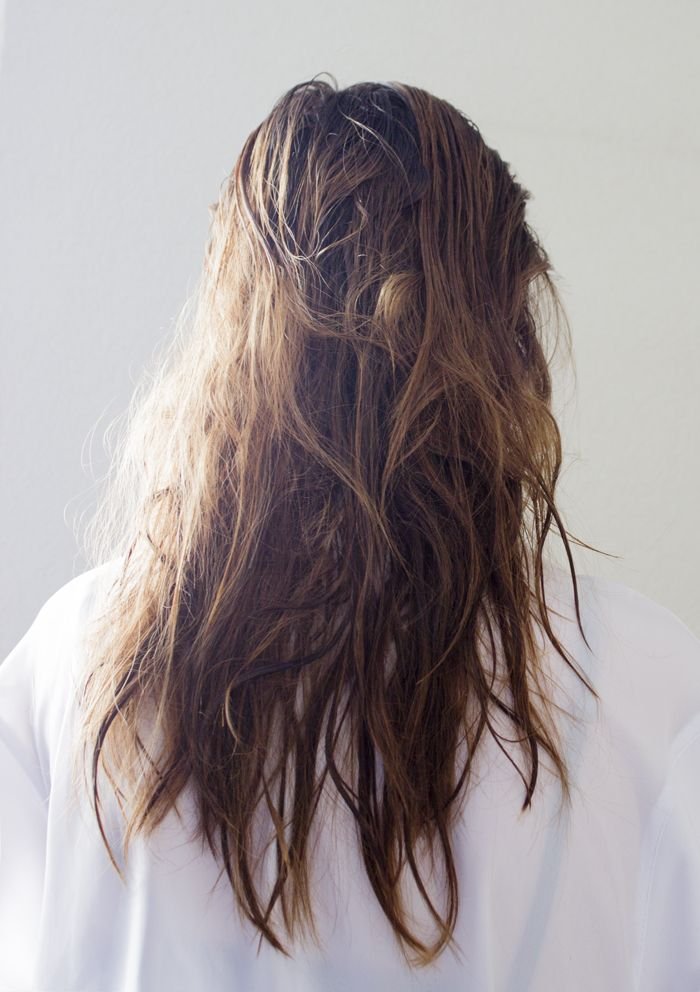
It was a Tuesday morning, the kind where you wake up ten minutes before you’re supposed to leave the house, and the first thing you see in the mirror isn’t your face — it’s your hair. Half of it is standing straight up like it’s trying to escape your skull, the other half is flattened against your scalp like it got run over by a truck, and somewhere in the middle there’s a knot so dense it could double as a bird’s nest. You reach for the brush, drag it through, and hear that unmistakable little crackle. A few strands come loose in your fingers. You sigh, tie it up, and move on with your day, quietly promising yourself that you’ll “deal with it later.”
Later never really comes, does it? Most of us have made peace with bad hair mornings the way we’ve made peace with Monday traffic — as something to be endured, not understood. But here’s the thing. Bedhead isn’t random. Breakage isn’t just bad luck. And split ends don’t appear out of nowhere like some kind of hair curse. There’s a very real, very physical explanation behind all three, and once you see it, you can’t unsee it. It’s not about your genes, and it’s usually not even about the products sitting in your bathroom cabinet. It’s about what happens to your hair during the seven or eight hours you spend not thinking about it at all — while you’re asleep.
The Night Shift Your Hair Never Signed Up For
Think about what your hair actually goes through at night. You lie down, and unlike your body, which mostly just rests, your hair keeps moving. Every time you shift position, roll onto your side, adjust your pillow, or simply breathe, your hair drags across fabric. Multiply that by the number of times you move in a night — research on sleep patterns suggests the average adult shifts positions somewhere between twenty and forty times — and you start to realize your hair isn’t resting either. It’s being dragged, twisted, pressed, and rubbed against a surface for hours on end, over and over, night after night.
Now think about the surface itself. Most pillowcases are cotton. Cotton feels soft to the touch when you’re awake and paying attention to it, but under a microscope, cotton fibers are rough and porous, full of tiny ridges. When your hair moves against that texture, especially while it’s slightly damp from natural oils or humidity, the outer layer of each strand — what’s called the cuticle — takes the hit. The cuticle is like the shingles on a roof: thin, overlapping layers of protective cells that lie flat when hair is healthy and lift up when hair is stressed or damaged. Cotton, night after night, acts like sandpaper on those shingles. It roughens them, lifts them, and eventually starts prying them apart.
This is the part almost nobody talks about: bedhead isn’t just your hair being “messy.” It’s the visible result of friction damage that started building up long before that morning. The tangles you fight with your brush are strands whose cuticles have been roughed up enough overnight that they’ve started to interlock with each other, like burrs sticking to wool. Smooth hair doesn’t tangle easily because the cuticle lies flat and strands slide past each other. Rough, damaged hair grabs on to its neighbors and refuses to let go.
The Night Shift Your Hair Never SignedWhy Some People Wake Up Fine and Others Wake Up in a Crisis Up For
If friction were the whole story, everyone would have the same morning hair chaos, but that’s clearly not true. Some people wake up, run their fingers through their hair, and walk out the door. Others need fifteen minutes and a detangling spray just to get a brush through it. The difference usually comes down to a combination of hair texture, hair porosity, and how dry the strands already were before they ever hit the pillow.
Curly and wavy hair, for instance, has more surface area exposed to friction because of its shape — each curve and bend is another point of contact with the pillowcase. Straight hair tends to lie flatter and experiences slightly less overall friction, but it’s not immune, especially if it’s fine or has been color-treated, both of which make the cuticle more fragile to begin with.
Porosity plays a role too. Hair with high porosity — meaning the cuticle already has gaps or lifted spots, often from heat styling, coloring, or chemical treatments — absorbs and loses moisture quickly. Dry hair is brittle hair, and brittle hair breaks under friction far more easily than hair that’s still holding on to some internal moisture. So the same night, the same pillowcase, the same amount of tossing and turning can leave one person with slightly tousled waves and another with a tangled mess and three strands stuck to their hairbrush.
The Slow Story of a Split End
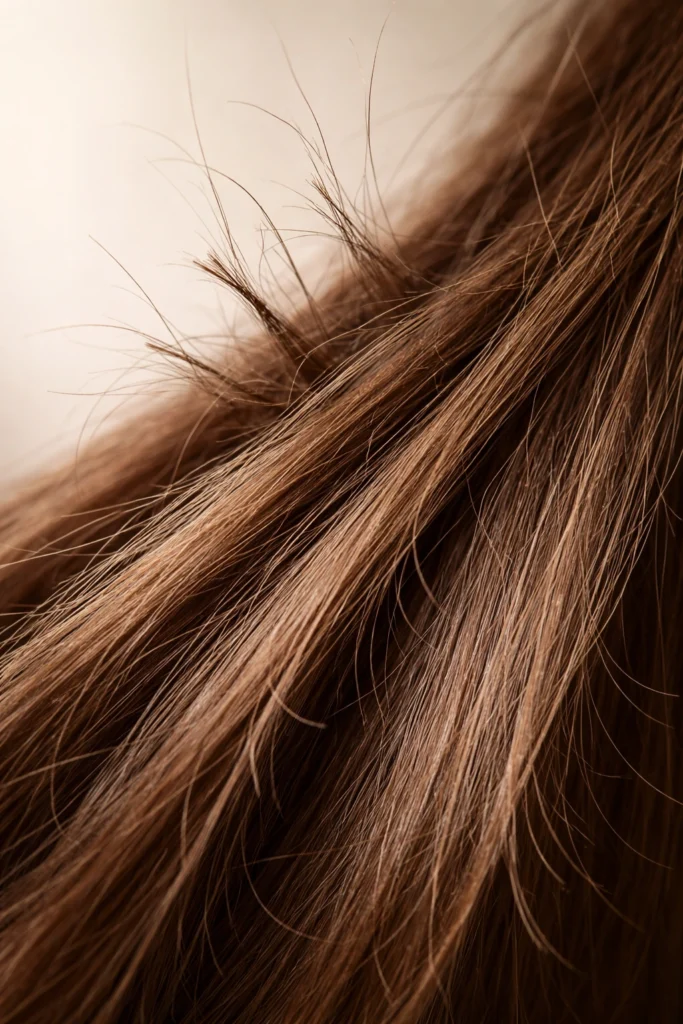
Split ends feel like they show up overnight, but they’re actually the final chapter of a story that’s been unfolding for weeks, sometimes months. It starts small. A little friction here, a little heat there, a rough towel-dry one too many times, and the cuticle at the very tip of the strand — the oldest, most exposed part of your hair, since hair grows from the root and the tips have been through the most life — starts to wear thin.
Once the cuticle wears away in a spot, the inner layer of the hair, called the cortex, is left exposed with nothing protecting it. The cortex is where the hair’s strength and elasticity actually live, and it was never built to handle direct exposure to friction, heat, or dry air. It starts to fray, the way a rope frays when the outer casing wears through and the inner threads start to separate. Eventually, the strand can’t hold together anymore, and it splits — sometimes into two thin filaments, sometimes into several, in what stylists sometimes call a “tree branch” split when it’s especially bad.
Here’s what most people get wrong about split ends: they think product can fix them. It really can’t. Once a strand has split, no serum, oil, or leave-in conditioner can weld it back together. What those products do is coat the area and smooth it temporarily, so the ends look better and don’t catch as easily, but the underlying damage is already done. The only real fix for an existing split end is a trim. This is why prevention matters so much more than people give it credit for — because by the time you can see the damage, you’re not treating a problem, you’re just managing the aftermath.
And nighttime friction is one of the single biggest, most overlooked contributors to that slow fraying process, precisely because it’s invisible and repetitive. A single rough night doesn’t split a hair. But hundreds of rough nights in a row, on the same rough pillowcase, absolutely will.
The Brush You've Been Using Wrong the Whole Time
Somewhere in the middle of untangling all this, it’s worth talking about the brush itself, because most people treat brushing as a purely mechanical, thoughtless act — grab, drag, done — without realizing that the tool and the technique matter almost as much as the hair itself.
Picture the typical morning ritual. Hair is a mess, there’s a knot near the nape of the neck, and the instinct is to start at the top of the head and pull the brush straight down through the whole length in one motion. That single habit, repeated every single day, is responsible for an enormous amount of unnecessary breakage. When you drag a brush from root to tip through a knot, all the tension in that tangle gets transferred straight to the root, and the strand either rips free from the follicle or snaps somewhere along its length, usually right around the knot itself, which is exactly where the cuticle has already been roughed up the most.
The better approach, the one most stylists will tell you almost on autopilot, is to start at the very ends and work upward in small sections, loosening knots gradually instead of forcing them out in one aggressive pull. It takes longer. It’s less satisfying in the moment, especially when you’re already running late. But it’s the difference between gently working out a problem and repeatedly punishing your hair for a mess it didn’t choose to make.
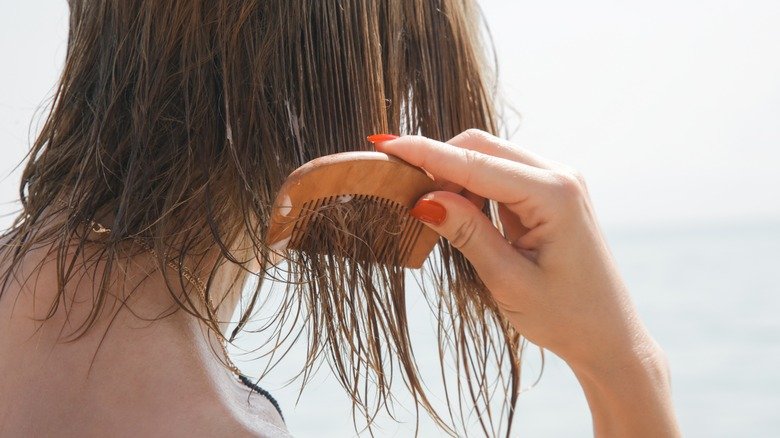
The type of brush matters too. A hard, tightly packed bristle brush dragged through dry, tangled hair creates a lot of friction very quickly, compounding the exact problem caused by the pillowcase the night before. A wide-tooth comb, or a brush with more flexible, widely spaced bristles, distributes the pulling force more evenly and is simply gentler on strands that have already spent all night getting roughed up. None of this is exotic advice. It’s the kind of thing hairdressers repeat so often it barely registers as information anymore, but it’s exactly the kind of small daily habit that decides whether the friction from the night before turns into a manageable tangle or an actual broken strand.
The Heat Styling Debt That Builds Up Quietly
There’s another layer to this story that deserves its own moment, because it rarely gets connected to the nighttime friction conversation, even though the two are deeply intertwined. Heat styling — blow dryers, straighteners, curling irons — doesn’t just change the shape of hair temporarily. Every single pass of high heat softens the protein bonds inside the strand and, over repeated use, gradually weakens the cuticle’s ability to lie flat and protect the cortex underneath.
Here’s where it connects back to everything already discussed. Hair that’s already been softened and slightly damaged by regular heat styling arrives at bedtime in a more vulnerable state than hair that’s never touched a flat iron. That same friction from a cotton pillowcase that might only rough up healthy, unstyled hair a little can do considerably more damage to hair whose cuticle was already compromised earlier that day by a blow dryer set too hot or a straightener passed over the same section three or four times to get it “just right.”
This is why some people who style their hair heavily notice they seem to get split ends faster than friends who wear their hair naturally, even if their nighttime habits look identical. It’s not that heat styling and pillow friction are two separate problems — they’re the same problem, compounding on the same vulnerable strand, from two different directions, morning and night.
The Wet Hair Mistake Almost Everyone Makes
There’s a very specific and very common scenario that makes everything worse, and it happens to people who consider themselves diligent about their hair. They shower at night, maybe to save time in the morning, and they go to bed with their hair still damp, or they wake up in the middle of the night having slept on hair that hadn’t fully dried before they passed out from exhaustion.
Wet hair is significantly weaker than dry hair. The internal hydrogen bonds that give hair its strength and shape are disrupted by water, and until the hair dries and those bonds reform, the strand is in a much more fragile, stretchy state — almost like a wet noodle compared to a dry one. Brushing wet hair, pulling it into a tight bun while it’s damp, or simply lying on it and letting it get crushed and twisted against a pillow puts an enormous amount of stress on hair that has no structural defense left. This is often the single biggest reason someone wakes up with far more breakage than usual, more shed hairs on the pillow, and knots that feel almost impossible to work through. It’s not that their hair got weaker overnight in some mysterious way — it went to bed already weakened, and then had eight hours of movement and friction added directly on top of that vulnerability.

The Ponytail You Forgot You Were Wearing
Another quiet contributor to this whole mess is what people do with their hair right before bed without really thinking about it. A lot of people tie their hair up out of habit — a bun to keep it out of their face, a ponytail because it’s what they did all day and never took out, a tight braid because someone told them it prevents tangles.
The irony is that a tight hairstyle worn to bed often creates more damage than it prevents. Hair pulled tightly against the scalp all night puts sustained tension on the strands at the point where the hair tie sits, and that constant pulling, combined with the friction from moving your head against the pillow while your hair is anchored in one spot, creates a stress point that’s remarkably good at causing breakage right at that band. People who wake up and notice a strange little tuft of shorter, frizzy hairs at the same spot on their head every morning are often looking at exactly this kind of repeated tension damage, without realizing that the hair tie itself, not just the pillow, played a starring role.
Loose is almost always better for overnight hair, and if hair absolutely must be secured, a loose, low style with a soft fabric tie causes far less repeated stress than anything pulled tight.
A Conversation With a Stylist That Changed How I Thought About All of This
A while back, sitting in a salon chair getting a trim, I asked the stylist the question everyone eventually asks: why do my ends keep splitting even though I trim them regularly and I don’t even use heat that often? She paused mid-snip, looked at the ends she’d just cut off, and asked a question back instead of answering mine. “What do you sleep on?”
I told her a regular cotton pillowcase, the same one I’d had for years, and she nodded like she already knew the answer before I said it. She explained, running her fingers through a section of my hair to show me where the damage was concentrated, that the ends were splitting in a pattern that lined up almost exactly with where hair would rub against a pillow the most during sleep — not randomly across the whole head, but concentrated toward the parts that would have the most contact with a rough surface for hours every night.
She wasn’t trying to sell me anything, which is part of why it stuck with me. She said the same thing about half her clients: they were doing everything right during the day, careful shampoo, decent conditioner, occasional trims, minimal heat, and still ending up in her chair every few months more frustrated than the last. And nearly every single time, when she asked about their nighttime habits, there was some combination of a rough pillowcase, hair tied up tight, or a habit of going to bed with damp hair straight out of a late shower.
It was such a simple explanation that it almost felt anticlimactic. There was no dramatic diagnosis, no expensive treatment being pitched, just a quiet observation that the hours spent unconscious were doing more damage than the hours spent awake and actively trying to take care of things. It reframed the whole problem for me. I’d been treating my hair care routine like something that happened in the bathroom, in front of a mirror, with products and tools I could control and see. It never occurred to me that the most damaging part of my entire day was happening while I was completely unaware of it, face down on a pillow, dead asleep.
What the Fabric Actually Does, and Why It Matters More Than People Think
It’s worth slowing down on this point because it’s the one detail that quietly explains most of the mystery. Cotton pillowcases aren’t bad because they’re cheap or unfashionable — they’re a problem specifically because of their fiber structure. Cotton is woven from short, somewhat coarse fibers, and even a high thread count cotton still has a textured surface at the microscopic level that grips hair rather than letting it glide.
Smoother fabrics — silk and satin being the most commonly recommended alternatives — have a different fiber structure that allows hair to slide across the surface with much less resistance. Less resistance means less mechanical stress on the cuticle, which means less lifting, less roughening, less tangling, and over time, less breakage and fewer split ends. This isn’t a marketing gimmick dreamed up to sell expensive pillowcases; it’s a fairly straightforward matter of surface friction, the same principle that explains why it’s easier to slide a book across a polished table than across a carpet.
This single, small environmental factor — the texture of what your head rests on for a third of your life — turns out to be one of the most influential and least discussed causes of everything from morning tangles to long-term strand damage. It’s not glamorous. It’s not a miracle ingredient or a new trend. It’s just physics, playing out quietly every single night, on nearly everyone’s pillow, whether they know it or not.
The Dry Air Problem Nobody Notices
Bedrooms are rarely humidity-neutral spaces. In winter, heaters strip moisture out of the air. In summer, air conditioning does much the same thing, pulling humidity out to keep things cool and comfortable. Either way, the air surrounding your head while you sleep is often drier than it feels, and dry air pulls moisture out of hair the same way it pulls moisture out of skin, leaving strands more brittle and more prone to snapping when they’re pushed and pulled against a pillow all night.
This is part of why people often notice their hair feels worse in the depths of winter or during long stretches of dry summer heat — it’s not a coincidence of the calendar, it’s the actual moisture content of the surrounding air changing how much stress the hair can handle before it breaks. Combine dry indoor air with a rough pillowcase and hair that was already a little thirsty from heat styling or color treatment, and you’ve built the perfect conditions for a rough morning.
Diet, Water, and the Things Happening Beneath the Surface
Hair health doesn’t start at the ends; it starts at the follicle, and the follicle is fed by everything happening inside the body. Someone who isn’t getting enough protein, iron, or key vitamins may grow hair that’s simply weaker from the moment it emerges from the scalp, regardless of how gently it’s treated afterward. This doesn’t mean every case of breakage is a nutritional deficiency — far from it — but it does mean that two people can follow the exact same nighttime routine and end up with very different results, because one of them started with structurally stronger hair to begin with.
Water matters too, in a more literal sense. Hard water, which carries a heavier mineral content, can leave a residue on hair that makes it feel rougher and less able to retain moisture, which again feeds back into that same cycle of dryness, brittleness, and breakage. Someone who showers every day in hard water might notice their hair simply feels different after moving to a place with softer water, even if nothing else about their routine changed, which is a strong hint at how much this quiet, invisible factor actually contributes.
It’s rarely just one cause acting alone; it’s usually several of these factors layering on top of each other, quietly, until one particular morning the accumulated effect finally becomes visible in the mirror. A person with slightly low iron, who showers in hard water, who blow-dries on high heat most mornings, and who sleeps on a rough cotton pillowcase isn’t dealing with four small unrelated problems. They’re dealing with one compounding problem wearing four different disguises, and until one of those layers gets addressed, the mirror keeps delivering the same disappointing verdict every morning.
Piecing the Whole Picture Together
So here’s the honest, unglamorous truth: morning bedhead, hair breakage, and split ends are rarely caused by one dramatic thing. They’re caused by an accumulation of small, repeated, mostly invisible stresses — friction from rough fabric, tension from tight hairstyles, weakness from going to bed with damp hair, dryness from indoor air, and a baseline hair strength that’s shaped by diet, water quality, and whatever heat or chemical treatments the hair has already been through. None of these factors are exotic. All of them are things most people do without a second thought, night after night, for years.
The good news buried inside all of this is that because the causes are mechanical and environmental rather than mysterious or genetic, they’re also fixable, or at least manageable, without needing to overhaul an entire routine overnight. Switching to a smoother pillowcase fabric, making sure hair is fully or mostly dry before bed, loosening up nighttime hairstyles, keeping some moisture in both the hair and the surrounding air, and getting regular trims to remove existing split ends before they travel further up the strand — these small shifts, stacked together, address almost every mechanism described above. Nothing here requires an expensive salon treatment or a drastic change in identity. It just requires understanding what’s actually happening while you sleep, and making peace with the idea that hair, like skin, is a living, physical thing that responds to how it’s treated, even during the hours when you’re not paying attention to it at all.
The next time you wake up, glance in the mirror, and feel that familiar flash of frustration at the tangled mess staring back at you, it might help to remember that it isn’t random, it isn’t bad luck, and it isn’t some unsolvable mystery of your particular hair type. It’s friction, tension, dryness, and time, all quietly doing their work while you were somewhere else entirely, dreaming. And once you know that, you’re no longer just reacting to bad hair mornings — you’re in a position to actually do something about the nights that cause them.
Frequently Asked Questions
Does a silk or satin pillowcase really make a difference for hair breakage?
because of reduced friction. Smoother fabric lets hair glide instead of catching, which means less cuticle damage and fewer tangles over time.
Can split ends be repaired without cutting them off?
Not truly. Products can smooth and disguise split ends temporarily, but the strand itself stays split until it’s trimmed away.
Is it bad to sleep with wet hair every night?
It’s not ideal, since wet hair is weaker and more prone to stretching and breaking. Letting hair dry mostly or fully before bed, or using a loose protective style, helps reduce that damage.