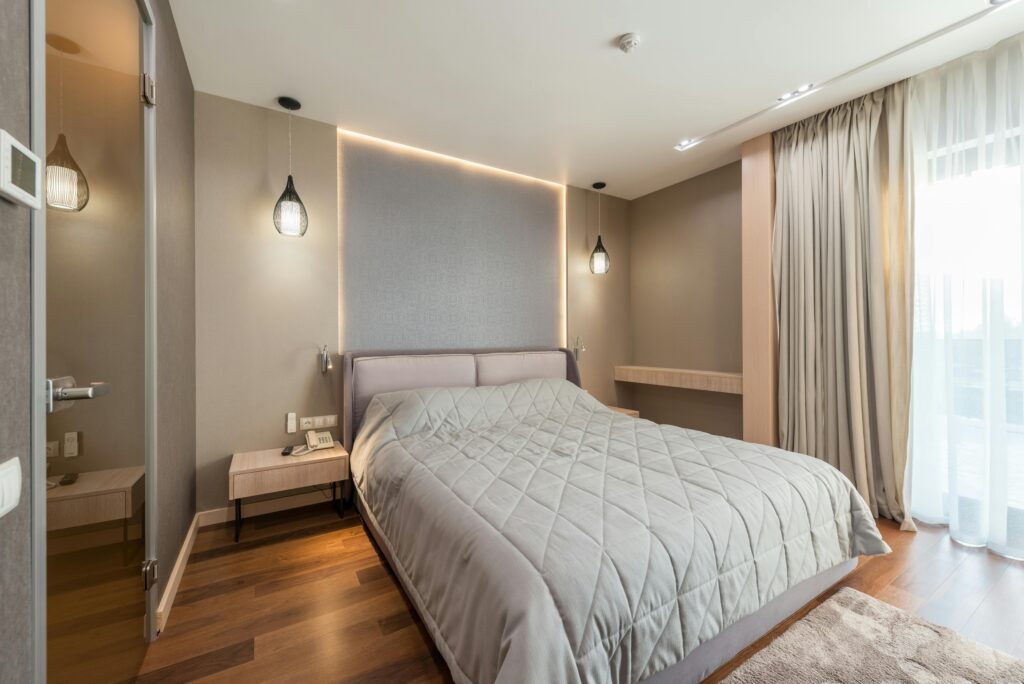
Maria bought the sheets because they looked expensive in the photograph. Matte black, almost inky, the kind of bedding that shows up in interior design reels next to a single dried eucalyptus branch and a candle nobody ever lights. She’d been redoing her bedroom for months, chasing that moody hotel-suite look, and the final piece was the bed itself. So she ordered the 400-thread-count set in “Midnight,” ironed the wrinkles out on a Sunday afternoon, and made the bed with the kind of satisfaction that only comes from finally finishing a project you’ve been putting off.
That night, she turned off the lights the way she always did, pulled the blanket up, and closed her eyes.
Except she didn’t need to close her eyes. That was the first strange thing she noticed. Normally there’s a difference between eyes-open-in-the-dark and eyes-closed — a faint textured grey versus a flatter black. That night, lying under the new sheets with the lights off, there was no difference at all. Open or closed, the world was the same depthless nothing. And somewhere around midnight, her heart started doing something it doesn’t usually do at bedtime. A tightness crept into her chest. Her arms felt like they didn’t have anywhere to go. She actually reached out and touched the wall to check where the room ended, because for a second, lying there, she genuinely wasn’t sure.
She got up, turned on the lamp, and stared at her new sheets like they’d personally wronged her.
If you’ve never had a night like that, this might sound dramatic. Bedsheets are bedsheets. But if you have — if you’ve ever bought the black-out curtains, the charcoal duvet, the dark academia bedroom of your dreams, and then found yourself lying awake at 2 a.m. with your pulse in your throat for no reason you can name — then you already know there’s something going on here that has nothing to do with taste and everything to do with how your brain processes the absence of light. People have started calling it, half-jokingly and half-seriously, the darkness depth theory. It doesn’t have a textbook entry yet. But it’s built on real, well-documented quirks of human perception, and once you understand what’s actually happening, the 2 a.m. panic stops feeling irrational and starts feeling like exactly what it is: your visual system doing its best with no information at all, and guessing wrong.

The idea in plain terms
Here’s the core of it, stripped of any jargon. Your eyes are constantly, unconsciously measuring the world. Not just “what is that” but “how far away is that,” “how big is this room,” “where is the edge of things.” You almost never think about this happening because it happens instantly and automatically, using dozens of small visual tricks working together: the way light falls off a wall as it recedes, the way a doorway looks smaller the further it is, the way two eyes see slightly different angles on the same object and your brain triangulates the gap into a sense of depth. Even in a dim room, with just a sliver of hallway light or the blue glow of a phone charger, your brain has enough scraps of information to stitch together a rough 3D map. You know, without thinking about it, that the ceiling is up there and the wall is over there and there is a good three feet of open air between your face and anything solid.
Pitch black takes all of that away in one go. Not dim — pitch black, the specific kind of true, absorbent darkness that very dark bedding, thick blackout curtains, and a windowless room can produce together. There’s no gradient of light to judge distance by. There’s no edge, no corner, no horizon. Your two eyes, which normally disagree slightly and let your brain calculate depth from that disagreement, now agree on absolutely nothing, because they’re both looking at the same undifferentiated void. And your brain, which is not built to tolerate a total absence of spatial data, doesn’t just shrug and go to sleep. It fills in the blank. Sometimes it fills it in with “the room must be enormous, an open field, nothing around you.” That’s the version people describe as peaceful, floaty, almost meditative. But sometimes — and this seems to depend on the person, their history, their anxiety baseline, even what kind of day they’ve had — it fills in the blank with the opposite guess: “there is no room, there is no edge, and if there’s no edge then maybe the walls have closed in.” That’s the version that produces the tight chest, the racing pulse, the hand reaching out to touch a wall just to confirm it’s still where it’s supposed to be.
This is the whole premise of the darkness depth theory: claustrophobia in the dark isn’t really about small spaces at all. It’s about missing depth information, and a brain that would rather guess “trapped” than sit with a total absence of data.
Why your eyes hate a flat black room more than a dim one
To understand why this specific kind of blackness is different from ordinary nighttime darkness, it helps to know a little about how depth perception actually works, because most people assume vision is just “light comes in, image appears,” when really it’s closer to a committee of separate systems voting on an answer.
One of those systems is binocular disparity — the slight difference between what your left eye sees and what your right eye sees, which your brain compares to judge how far away something is. Hold a finger a few inches from your nose and look at it with one eye closed, then the other; it appears to jump sideways. That jump is bigger for close objects and smaller for distant ones, and your brain has been doing this math since infancy without you ever noticing. In a truly lightless room, both eyes report exactly the same thing: nothing. There’s no jump to measure, no disparity to calculate, so this whole channel goes dark, no pun intended.
Another system is what researchers call monocular depth cues — things you can judge with just one eye, like the way parallel lines appear to converge in the distance, the way objects overlap each other, the way surfaces get hazier and less detailed the farther away they are, and the way light falls off in intensity and creates shadow gradients that tell your brain “this part of the wall is closer to the light source, this part is farther.” Every one of these depends on being able to see something. In true blackness, all of them vanish simultaneously, not gradually. It isn’t dusk. It’s an on-off switch for your entire depth-perception toolkit, all at once, with nothing to smooth the transition.
There’s a third, subtler thing happening too, something vision scientists call the Ganzfeld effect, named after the German for “entire field.” It was first studied in the 1930s by a perceptual psychologist looking at how birds fixate on featureless backgrounds, and later became famous through experiments where people stared into a uniform field of light or fog with no edges or texture at all. What researchers found again and again is that a totally uniform visual field — whether it’s white fog or absolute black — doesn’t read to the brain as “calm nothingness.” It reads as a kind of sensory static. Some people in Ganzfeld experiments reported mild hallucinations. Many reported anxiety. A featureless field, it turns out, isn’t restful for a brain built to constantly extract information from edges and contrast. It’s closer to the visual equivalent of a dial tone: technically silence, but a silence your ears strain against, waiting for a signal that never comes.
Put those three things together — no binocular disparity, no monocular cues, and a featureless field triggering low-grade sensory static — and you get a room that isn’t just dark. It’s a room your visual system experiences as actively unresolved, an unanswered question it keeps quietly trying to answer all night long. For most people, most of the time, the brain settles on “empty and vast” and drifts off without incident. But it doesn’t always land there, and pitch-black bedding — because it removes even the faint contrast a lighter blanket would offer against the dark room around it — seems to nudge some people’s brains toward the other answer.
Why your eyes hate a flat black room more than a dim one
To understand why this specific kind of blackness is different from ordinary nighttime darkness, it helps to know a little about how depth perception actually works, because most people assume vision is just “light comes in, image appears,” when really it’s closer to a committee of separate systems voting on an answer.
One of those systems is binocular disparity — the slight difference between what your left eye sees and what your right eye sees, which your brain compares to judge how far away something is. Hold a finger a few inches from your nose and look at it with one eye closed, then the other; it appears to jump sideways. That jump is bigger for close objects and smaller for distant ones, and your brain has been doing this math since infancy without you ever noticing. In a truly lightless room, both eyes report exactly the same thing: nothing. There’s no jump to measure, no disparity to calculate, so this whole channel goes dark, no pun intended.
Another system is what researchers call monocular depth cues — things you can judge with just one eye, like the way parallel lines appear to converge in the distance, the way objects overlap each other, the way surfaces get hazier and less detailed the farther away they are, and the way light falls off in intensity and creates shadow gradients that tell your brain “this part of the wall is closer to the light source, this part is farther.” Every one of these depends on being able to see something. In true blackness, all of them vanish simultaneously, not gradually. It isn’t dusk. It’s an on-off switch for your entire depth-perception toolkit, all at once, with nothing to smooth the transition.
There’s a third, subtler thing happening too, something vision scientists call the Ganzfeld effect, named after the German for “entire field.” It was first studied in the 1930s by a perceptual psychologist looking at how birds fixate on featureless backgrounds, and later became famous through experiments where people stared into a uniform field of light or fog with no edges or texture at all. What researchers found again and again is that a totally uniform visual field — whether it’s white fog or absolute black — doesn’t read to the brain as “calm nothingness.” It reads as a kind of sensory static. Some people in Ganzfeld experiments reported mild hallucinations. Many reported anxiety. A featureless field, it turns out, isn’t restful for a brain built to constantly extract information from edges and contrast. It’s closer to the visual equivalent of a dial tone: technically silence, but a silence your ears strain against, waiting for a signal that never comes.
Put those three things together — no binocular disparity, no monocular cues, and a featureless field triggering low-grade sensory static — and you get a room that isn’t just dark. It’s a room your visual system experiences as actively unresolved, an unanswered question it keeps quietly trying to answer all night long. For most people, most of the time, the brain settles on “empty and vast” and drifts off without incident. But it doesn’t always land there, and pitch-black bedding — because it removes even the faint contrast a lighter blanket would offer against the dark room around it — seems to nudge some people’s brains toward the other answer.
An old fear wearing new sheets
There’s a reason this particular misfire — depthless dark reading as “trapped” rather than “open” — shows up so consistently across people who otherwise have no history of claustrophobia. It’s worth going back further than bedroom design trends to understand where the wiring comes from.
For most of human history, and for the entire evolutionary stretch before that, true, total darkness meant one thing above almost everything else: you were somewhere enclosed. Open landscapes, even at night, carry ambient light — starlight, moonlight, the low glow of a horizon — enough for a nocturnal predator or a wary human ancestor to make out silhouettes and shapes. The only places dark enough to swallow that ambient light entirely were caves, dense forest canopy, underground spaces, places with walls close enough to block out the sky. Total blackness, in other words, was historically a very reliable signal for “you are inside something,” and often, specifically, “you are inside something with limited ways out.”
It makes sense, then, that the nervous system would treat that specific quality of pitch-black — not dim, not shadowy, but total and featureless — as a red flag worth acting on, even in a bedroom with a perfectly good door six feet away. Your amygdala, the part of the brain heavily involved in threat detection, doesn’t check your lease agreement before it responds. It responds to the sensory pattern. And a completely lightless room, especially one where even your own blanket disappears into the same undifferentiated black as the air around it, produces almost exactly the sensory pattern of being enclosed in rock.
This is part of why the fix so many people stumble onto by accident works as well as it does: a sliver of light under the door, a small nightlight, even the dim red glow of a charger across the room. It’s not that the room becomes meaningfully brighter. It’s that a single point of contrast gives the visual system one edge to measure everything else against, and one edge is apparently often enough to convince the brain that this is an ordinary room and not a sealed chamber. People who swear they can’t sleep without “some kind of light, I don’t even know why” are, in a very literal sense, self-medicating a depth-perception problem they’ve never had named for them.
What it actually feels like, in other people's words
Talk to enough people about this and the same shape of story comes up again and again, even though nobody seems to have compared notes with anyone else beforehand.
A man in his thirties, redoing his apartment after a breakup, described going all-in on a “cave bedroom” aesthetic — charcoal walls, near-black linen sheets, blackout blinds installed for the first time in a home that had never had them. The first week was fine, even good, he said, deep uninterrupted sleep. The second week, he woke up around 3 a.m. convinced the ceiling had somehow dropped, that there was less air above him than there should be. He described patting the wall next to the bed “like an idiot” just to make sure it was where he remembered it. He didn’t have a history of anxiety and had never experienced anything like claustrophobia before. He assumed, reasonably, that something was wrong with him. What he eventually landed on, after cracking the blinds and switching to a lighter grey duvet, was that the problem had never been him. It had been the specific, total absence of any visual edge in the room.
A woman who works night shifts and sleeps during the day described a similar experience with blackout curtains alone, no dark bedding involved — proof that it’s really about the totality of the darkness, not any one product. She’d installed proper industrial blackout curtains to sleep through daylight, and the first few times, lying in a room gone fully black at 9 a.m., she felt a wave of dread she couldn’t place, worse on days she was already stressed about something unrelated. She started keeping a small battery-powered light in the corner, not on, just visible as an unlit shape a shade darker than the surrounding black — and found that even that faint, almost nonexistent distinction in the dark was enough to keep the panic from showing up.
A third person, a teenager whose parents had painted her room a deep navy for her birthday because she’d asked for it, mentioned to a school counselor that she’d started sleeping with her closet light on, cracked door, even though she used to be completely fine with the dark. She wasn’t scared of monsters. She said, in almost exactly these words, that the room “didn’t feel like it had a shape anymore” once it was fully dark, and that not knowing the shape of the room made her feel like the walls were somehow closer than they used to be.
None of these are clinical case studies. They’re the kind of thing people mention in passing, embarrassed, assuming it’s a personal quirk, when it’s really a fairly predictable output of a very specific visual condition: total, edge-free, contrast-free blackness, sustained over hours, in a space your body is supposed to feel safe and unguarded in.

The flotation tank comparison, and why it cuts both ways
If you want proof that total sensory blankness can go either direction — blissful or distressing, depending on circumstances — you don’t have to look further than sensory deprivation tanks, sometimes called float tanks. People pay good money to lie in total darkness and silence, floating in body-temperature salt water, precisely because for many people that total absence of input is profoundly relaxing. Freed from visual and auditory information entirely, some people report a loosening of anxiety, a kind of mental quiet that’s hard to access any other way.
But float tank operators will also tell you, if you ask honestly, that a meaningful fraction of first-time users have to be talked through a wave of panic in the first few minutes. The tank is small. The water is shallow and warm and eerily still. The dark is complete. For some people that reads as freeing — nothing to see, nothing to hold onto, no reason to be anywhere but exactly where you are. For others, the exact same sensory conditions read as suffocating, and the absence of any visual boundary makes the actual, physical boundary of the tank feel like it’s pressing in, even though nothing about the tank itself has changed.
The parallel to a pitch-black bedroom is almost exact, which is part of why the darkness depth theory holds up as an explanation rather than a coincidence. It isn’t that dark rooms or float tanks are inherently threatening. It’s that removing all visual depth information creates a kind of perceptual coin flip, and which way it lands seems to depend on things like a person’s general anxiety level, their specific sensitivity to unresolved sensory input, whether they’ve had claustrophobic experiences before, and even just how their particular nervous system happens to be wired that week. Some brains fill the void with calm. Some fill it with alarm. Total darkness doesn’t cause claustrophobia so much as it removes the evidence that would normally talk your brain out of it.
Why the design world never saw this coming
Part of what makes this theory interesting is how invisible it’s been to the people actually designing and selling these rooms. Dark, moody bedrooms have been an interior design darling for years — deep charcoal walls, near-black bedding, minimal light sources, all sold as sophisticated, cocooning, restful. And for a genuinely large number of people, that’s exactly what it delivers. Dark colors do generally read as calming and enclosed in a good way, and there’s real, separate research on how a slightly darker, cozier bedroom can support better sleep for people who are sensitive to light pollution.
What almost never gets mentioned in the glossy design coverage, though, is the difference between a dark room and a depthless one. A charcoal wall with visible texture, catching even a hint of ambient light, still gives your eyes something to hold onto — a faint gradient, a slightly lighter corner, a shadow that shifts as your eyes adjust. That’s a dark room. A room where the bedding, the walls, and the air all disappear into one indistinguishable black, with zero light sources anywhere, night after night — that’s a depthless room, and it’s a much smaller, much more specific category. Most bedrooms marketed as “moody” or “dark academia” never actually reach true depthless blackness, because most homes have some light leak somewhere: a streetlight through a gap in the curtain, a hallway strip under the door, a smoke detector’s tiny standby light. It’s really only when someone deliberately chases the aesthetic all the way — proper blackout curtains, a dark bedding set, no electronics, no night light, nothing left glowing anywhere in the room — that the conditions for this to happen actually line up. Which is precisely the situation Maria found herself in, and precisely why it took her by surprise. She hadn’t set out to build a depthless room. She’d set out to build a good-looking one, and the depthlessness came along uninvited.
Getting your depth back without giving up the dark
None of this means anyone needs to abandon dark bedding or moody bedrooms, and it’s worth saying clearly that most people sleeping in dark rooms every night feel nothing but fine. The point of the darkness depth theory isn’t “dark rooms are dangerous.” It’s that if you’ve had an unexplained wave of nighttime unease that felt oddly like claustrophobia, in a room you otherwise love, there’s a very concrete, very fixable explanation available, and it usually doesn’t require repainting anything.
Maria’s fix, in the end, was almost embarrassingly small. She kept the black sheets — she still loved how they looked — and instead addressed the actual missing ingredient, which was any form of visual edge in the dark. She left her closet door cracked so a thin seam of hallway light fell across one wall. She swapped her opaque phone charger for one with a barely-visible indicator light, angled toward the corner of the room rather than at the bed. Neither change made the room noticeably brighter. Both changes gave her eyes exactly one fixed point to measure the rest of the darkness against, and that was apparently all her nervous system needed to stop guessing “enclosed” and start guessing “open” again. The tightness in her chest didn’t come back.
Other people land on slightly different versions of the same fix: a plug-in nightlight in the hallway rather than the bedroom itself, so the room stays properly dark but the doorway doesn’t vanish completely. A thin strip of LED light along the baseboard, dimmed low enough that it’s barely perceptible with eyes open, just enough to exist as a single line the brain can anchor to. Leaving one small window uncovered while blacking out the rest, so a faint outdoor glow gives the room a horizon even at 3 a.m. None of these require giving up the aesthetic. They just require understanding that the goal was never total blackness for its own sake — it was the feeling of a calm, enclosed, cocoon-like room, and it turns out that feeling depends on your brain being able to confirm the room actually has edges, rather than being asked to take that entirely on faith, alone, in the middle of the night.

There’s something almost funny about the whole thing, once you understand it. The bedroom design world spent years chasing the aesthetic of feeling wrapped up and safe in the dark, and it turns out the actual key to feeling safe in the dark was never more darkness. It was one small, deliberate crack of light, placed exactly where your eyes could find it — proof, repeated every night, that the room still has a shape, and so do you, and there’s exactly as much space around you as there was the night before.
FAQs
Is the darkness depth theory an actual scientific term?
Not officially — you won’t find it in a psychology textbook under that exact name. It’s a popular way of describing a real, well-documented perceptual effect: total darkness removes the visual depth cues your brain relies on, and the brain sometimes fills that gap with a false sense of enclosure.
Does this mean dark bedding or dark bedrooms are bad for sleep?
No. Most people sleep fine in dark rooms, and dim, low-light environments are generally good for sleep quality. The issue only tends to show up in truly depthless, edge-free blackness — no light leaks anywhere — which is a narrower and less common condition than an ordinary dark room.
What's the simplest way to fix the claustrophobic feeling without giving up a dark bedroom?
Add one small, fixed point of light — a cracked door, a dim nightlight in the hallway, or a low LED strip. It doesn’t need to brighten the room; it just needs to give your eyes a single edge to measure the darkness against.