Zara had stopped counting the nights. Somewhere around the third month of waking up at two or three in the morning with her chest pulling tight and a dry, scratchy cough building in her throat, she’d given up keeping track of exactly how often it happened. It just happened. Almost every night, in fact, in that same quiet, unwelcome way — she’d drift off fine, feel perfectly normal by ten, and then somewhere in the deep hours of the night, her breathing would change. A faint whistle on the exhale. A tightness that made her sit up and reach for the inhaler she now kept permanently on the nightstand, right next to the lamp.
She wasn’t new to asthma. She’d had it since she was a kid, mild enough that most years she barely thought about it. A dusty afternoon, a bit of pollen, the odd cold — those were her usual triggers, and they were predictable enough that she could see them coming. This was different. This was happening in her own bed, in her own bedroom, in the middle of the night, for no reason she could point to. And that was the part that unsettled her most. When you can’t identify what’s setting off your asthma, you start to feel like your own bedroom has turned against you.

It was her mother, of all people, who first said the thing out loud that Zara hadn’t wanted to consider. “How old is that pillow you sleep on?” She’d inherited it, actually — a soft, slightly lumpy feather pillow that had belonged to her grandmother, easily eight or nine years old by that point, maybe older. It was the kind of pillow you don’t think about because it’s simply always been there, molded over the years into a shape that fit her head perfectly. The idea that this comforting, familiar object might be the thing quietly wrecking her sleep felt almost like a betrayal.
But it turns out her mother was onto something that sleep doctors, allergists, and a fair number of researchers have been circling for decades. The relationship between old feather pillows and nighttime asthma is real, but it’s also more layered and more interesting than the simple story most people tell themselves, which usually goes something like: feathers are the problem, so throw them out and buy foam. The truth, once you actually follow it, points somewhere slightly different — and understanding that difference is what actually helps you sleep better.
The pillow itself isn't really the villain
Here’s the twist that surprised Zara when she finally sat down with an allergist: feathers themselves are not typically what triggers an asthmatic reaction. What she’d assumed — that the down and quills from the bird were somehow irritating her airway directly — wasn’t really how it worked in most cases. There is such a thing as a genuine feather or bird-protein allergy, and it does exist, but it’s a distinct and comparatively uncommon condition, more associated with people who keep birds as pets or work closely with poultry. For the vast majority of people who feel worse sleeping on old feather bedding, the actual allergen isn’t the feather at all. It’s what has moved in and made a home inside the pillow over the years: dust mites.
Dust mites are microscopic creatures, invisible to the naked eye, that don’t bite and don’t carry disease, but that live an entire, quietly disgusting life cycle inside our bedding, feeding almost exclusively on the flakes of dead skin that every human sheds by the millions each night. A pillow, any pillow, feather or synthetic, is basically an ideal mite habitat: warm from body heat, slightly humid from breath and sweat, and constantly restocked with food. The mites themselves aren’t the allergen. It’s their waste — the tiny fecal particles they produce in enormous quantities over a short lifespan — that contains proteins the human immune system can react to violently, especially in people who are already sensitized, the way many asthmatics are.
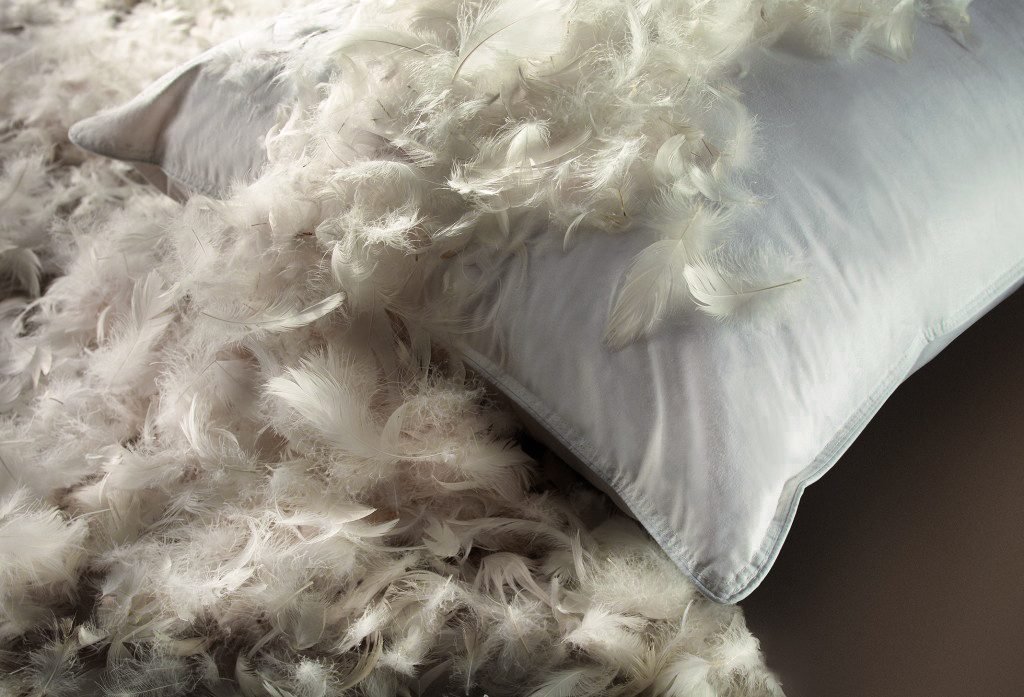
What Zara’s allergist explained, gently, was that an old pillow isn’t dangerous because it’s a feather pillow. It’s dangerous because it’s old. Over years of nightly use, any pillow — feather, synthetic, memory foam, buckwheat, doesn’t matter — accumulates a steadily rising load of mite waste, shed skin, sweat residue, and in humid climates, sometimes a bit of mold as well. Researchers who’ve measured this directly have found that a pillow that’s been in regular use for a couple of years can already carry a substantial concentration of the allergen protein produced by house dust mites, and that concentration tends to climb the longer a pillow stays in service without being washed or replaced. Some estimates suggest that by the time a pillow reaches the ten-to-twenty-year mark, a meaningful fraction of its total weight comes from mite waste, dead mites, and skin cells rather than its original stuffing.
That reframes the whole question. It’s not “are feathers bad for asthma.” It’s “how long has this particular pillow been quietly turning into a mite colony, and has anyone ever actually laundered it.”
What the research actually says, and why it's more surprising than expected
If you go looking for studies on feather bedding and asthma, expecting a clean verdict against feathers, you’ll actually run into something a bit more counterintuitive. Several observational studies conducted over the past couple of decades — including work out of the UK and Australia — found an inverse relationship between feather bedding and asthma symptoms, meaning kids and adults who slept on feather pillows and quilts sometimes reported fewer symptoms, not more, compared to those on synthetic bedding. One birth cohort study out of Northern Europe even found that children who used feather bedding from an early age were less likely to develop wheeze later on.
The proposed explanation for this had to do with the weave of the fabric covering the pillow rather than the filling inside it. Feather pillows, because down and feather stuffing is naturally slippery and prone to poking through loose fabric, are traditionally covered in a tightly woven ticking to keep the feathers contained. That same tight weave happens to be much harder for mites and mite waste to migrate through, and much harder for outside dust to penetrate into. Synthetic pillows, by contrast, are often covered in a looser, more breathable fabric, since there’s no slippery filling to contain — and that looser weave turns out to let more house dust and more mite allergen pass through and settle inside.
A study out of New Zealand that measured a specific mite allergen protein directly on bedding found synthetic pillows carrying meaningfully more of it than feather pillows, and synthetic duvets carrying dramatically more than feather duvets. A separate laboratory experiment placed freshly cleaned feathers, sourced from several manufacturers and confirmed free of mite contamination, into pillows and left them in real bedrooms known to have mite infestations for three months. The striking finding was that these feather pillows didn’t accumulate meaningful mite allergen internally during that period, whether they were covered with a protective case or not, again reinforcing the idea that the tight fabric barrier itself was doing a lot of the protective work.
None of this means feather pillows are magically immune to becoming allergen reservoirs over the long haul. It means the type of filling matters less than most people assume, and the condition and age of the pillow, along with how tightly it’s covered, matters a great deal more. A well-maintained ten-year-old feather pillow that’s been laundered periodically can, in some cases, carry less allergen than a two-year-old synthetic pillow that’s never been washed. It flips the usual assumption on its head, and it’s the kind of detail that gets lost in casual advice that just says “switch to hypoallergenic.”
There’s also a more rigorous piece of evidence worth knowing about: a randomized controlled trial in Australia took children who were already sensitized to dust mites and had moderate-to-severe asthma, gave everyone a mite-proof mattress cover, and then randomly assigned half of them new feather pillows and quilts while the rest kept standard bedding. A year later, researchers found no meaningful difference in asthma symptoms or lung function between the two groups. In other words, when researchers actually tested the question directly rather than just observing existing habits, feather bedding didn’t come out looking worse — and it didn’t come out looking dramatically better either. The honest scientific summary is that the fill material is a smaller factor than people think, and the real variable that keeps showing up again and again is age, cleaning frequency, and the overall mite burden of the whole bedroom, not just the one pillow.
Why the attacks happen specifically at night
This part took Zara longer to piece together, but it made sense once she heard it laid out. Nighttime asthma, sometimes called nocturnal asthma, has its own set of contributing mechanics that go beyond simple allergen exposure, and they stack on top of each other in a way that makes a mildly allergenic pillow into something that can trigger a genuine attack in the middle of the night rather than a mild sniffle during the day.
The first piece is proximity and duration. For roughly seven or eight hours, your face is pressed directly against or very close to your pillow, breathing in air that has passed just inches from a surface loaded with allergen. During the day you might walk past far larger reservoirs of dust and mite waste — a couch, a rug, a stack of old books — without much effect, because you’re not inhaling directly from six inches away for hours on end. A pillow gets a kind of concentrated, sustained exposure that few other objects in the house replicate.
The second piece is the body’s own rhythm. Lung function naturally dips somewhat during the night in almost everyone, asthmatic or not, partly because levels of cortisol, the hormone that helps keep airway inflammation in check, drop to their lowest point in the early hours of the morning. Airways that are already a little inflamed from mite exposure have less of that natural anti-inflammatory buffer to lean on at 3 a.m. than they do at 3 p.m., which is part of why nighttime symptoms so often feel disproportionately severe compared to daytime ones, even when the trigger itself hasn’t changed.
The third piece is posture. Lying flat changes how mucus drains, tends to increase congestion in the nasal passages, and in people who also have any degree of reflux, allows stomach acid to travel further up the esophagus, which can itself irritate the airway and worsen asthma symptoms independent of anything allergy-related. None of this needs to be present for a pillow-related nighttime attack to happen, but when it is present, it tends to compound whatever allergic trigger is already at work.
Put those three pieces together — concentrated, hours-long exposure to an allergen source; a natural nightly dip in the body’s anti-inflammatory defenses; and postural factors that independently make breathing harder while lying down — and it becomes much easier to understand how something as ordinary as an old pillow can specifically produce a pattern of chronic nighttime symptoms rather than a general, all-day sense of being unwell.
The allergist visit, and what testing actually showed
Zara’s allergist ran a standard skin-prick panel, testing for a handful of common indoor and outdoor allergens including two species of house dust mite. Within about fifteen minutes, the mite spots on her arm had puffed into unmistakable raised welts, considerably larger than the histamine control point used to confirm the test was working properly. Pollen and pet dander, by contrast, barely reacted at all. That was the piece of objective evidence that turned this from a family theory into an actual diagnosis: she wasn’t just imagining a connection between her bedroom and her symptoms. She had a real, measurable sensitization to house dust mite allergen, which meant any bedding item harboring a meaningful mite population had the potential to set off her airway.
What the allergist didn’t do, notably, was tell her to throw away every feather item she owned and replace everything with synthetic fill. Instead, the conversation was almost entirely about age, cleaning, and barriers — which lined up closely with what the research above actually shows. She was advised to treat the whole sleep environment as the target, not just the single pillow, though the pillow was clearly the most urgent piece given how old and unwashed it had been.
Rebuilding a bedroom that doesn't fight back
The changes she made were not dramatic or expensive, which surprised her a little, since she’d half expected to need to gut-renovate her bedroom. The single biggest one was retiring the inherited pillow. Not because feather filling was inherently worse, but because a pillow that old, that had likely never been washed in its life and had been used continuously for the better part of a decade, was almost certainly carrying a heavy mite load regardless of what was stuffed inside it. She replaced it with a newer pillow, and this time made sure it came in a tightly woven cover rather than a loose one, following the same logic that seemed to protect feather bedding in the research — the weave matters more than the material.
She also added a zippered, allergen-barrier pillow protector underneath the regular pillowcase, essentially a second skin for the pillow that’s specifically woven to block mite-sized particles from passing through in either direction. This is a cheap, unglamorous fix, but it’s one of the most consistently recommended interventions across allergy literature, because it stops the problem at the source rather than trying to manage symptoms after exposure has already happened.
Washing became a scheduled habit rather than an afterthought. Pillowcases went into the wash weekly, on the hottest setting the fabric could tolerate, since dust mites are killed reliably at temperatures upward of around 130 degrees Fahrenheit but survive cooler washes reasonably well, even if some of the allergen protein still gets rinsed away mechanically at lower temperatures. The pillow itself, when it was a machine-washable type, went through a wash and full dry cycle every few months, mirroring the guidance that most sleep and allergy organizations give: even a good pillow benefits from periodic washing every six months or so and generally shouldn’t be kept in continuous use for much longer than one to two years if allergy symptoms are a concern, considerably shorter than the five-to-ten-year lifespan people casually assume a pillow should have.
The mattress got the same encasement treatment, since mattresses are, if anything, an even larger mite reservoir than pillows simply due to their size and the sheer number of hours spent in direct contact with them. And she started paying attention to humidity, since dust mites thrive in moist air and struggle badly once relative humidity drops below roughly 50 percent. A small hygrometer in the bedroom confirmed the room had been sitting close to 65 percent humidity most nights, likely thanks to a window unit air conditioner that wasn’t dehumidifying well. Switching to a unit with a proper dehumidifying mode, and cracking a window on drier days, brought that number down meaningfully within a couple of weeks.
None of these changes were about eliminating feathers from her life in a panic. In fact, she kept feather bedding, just newer and properly encased. The changes were about attacking the actual mechanism — mite accumulation over time, humidity that lets mites flourish, and a lack of regular washing — rather than treating “feather” as a dirty word.
What it felt like once it started working
The change wasn’t instantaneous, and it’s worth being honest about that, because a lot of allergy advice online implies a switch flips the moment you buy a new pillow. Mite populations don’t vanish overnight even in a freshly cleaned environment, and any existing sensitization in the body takes some time to calm back down as exposure drops. For Zara, the first couple of weeks after making the changes were still a bit rocky, with occasional nighttime tightness, though noticeably less frequent than before. By around the six-week mark, the pattern that had defined months of her life — waking at two or three in the morning to reach for the inhaler — had largely disappeared. She still kept the inhaler on the nightstand, because old habits built around genuine caution don’t need to disappear entirely, but she wasn’t reaching for it most nights anymore.
What struck her most, looking back, was how much the fear of not understanding the trigger had added to the whole ordeal. Waking up in respiratory distress with no obvious explanation is frightening in a way that’s different from having a cold or being near a cat you know you’re allergic to. Once she had a concrete, physical explanation — a specific pillow, a specific measurable sensitization, a specific accumulation process that had been building for years — the nights stopped feeling random and started feeling manageable.
When it isn't actually the pillow
It’s worth saying clearly, though, that not every case of chronic nighttime asthma traces back to bedding, and it would do a disservice to pretend that swapping a pillow is a universal cure. Nocturnal asthma has several other very common drivers that deserve equal attention, and a responsible approach usually means ruling several of them in or out alongside the pillow question rather than fixating on just one.
Gastroesophageal reflux is a frequent, under-recognized contributor, since lying flat allows stomach acid to creep upward and irritate the airway, particularly after a heavy or late evening meal, and this can produce a nighttime cough and chest tightness that mimics an allergic flare almost exactly. Pets sleeping in or near the bedroom are another common overlooked source, since dander is lighter and more airborne than mite waste and spreads more readily through a room. Mold, particularly in bedrooms with poor ventilation, damp walls, or an air conditioning unit that isn’t properly maintained, can also trigger very similar nighttime symptoms and sometimes gets blamed on bedding when the real source is a damp patch behind a wardrobe or a musty air vent.
Undiagnosed sleep apnea deserves a mention too, since disrupted breathing during sleep can sometimes present with symptoms that get mistaken for asthma, particularly gasping or waking with a sense of chest tightness, even though the underlying mechanism is completely different and requires an entirely separate kind of treatment. And for people whose asthma has simply been undertreated or under-monitored for a while, a change as ordinary as a change in season, a new home, recent construction nearby, or even stress and changes in breathing pattern can shift a previously mild case into one with much more noticeable nighttime symptoms, independent of any single object in the bedroom.
This is really the core message an allergist or pulmonologist will usually try to get across: chronic nighttime asthma is a pattern worth investigating properly rather than guessing at, and while an old, unwashed pillow sitting inches from your face for eight hours a night is a very plausible and very common contributor, it’s one piece of a broader picture that includes humidity, other allergen sources, reflux, and the general state of one’s asthma control overall.
The honest, complete answer
So, can an old feather pillow trigger chronic nighttime asthma attacks? Yes, it very plausibly can, but not for the reason most people assume. It’s rarely the feathers themselves causing trouble; it’s the years of accumulated dust mite waste, skin cells, and occasionally mold that build up inside any pillow left in continuous use without being washed or replaced, feather or otherwise. In fact, the tightly woven fabric traditionally used to cover feather pillows can make them somewhat more resistant to mite penetration than many synthetic alternatives, which is why some research has found feather bedding associated with fewer symptoms rather than more. What actually predicts trouble is age, hygiene, humidity, and the tightness of the pillow’s covering, not the fill material printed on the label.
For anyone lying awake at three in the morning wondering whether their pillow is somehow working against them, the reasonable next steps are straightforward: get properly tested for a dust mite sensitivity rather than guessing, encase both pillow and mattress in allergen-barrier protectors, wash bedding regularly in hot water, retire pillows that have been in continuous unwashed use for more than a couple of years, and keep bedroom humidity on the drier side. And if symptoms persist despite all of that, it’s worth widening the search beyond the pillow entirely, since reflux, pets, mold, and untreated sleep apnea can all produce a nearly identical nighttime pattern. The bedroom that once felt like the enemy can, with a bit of unglamorous maintenance, go back to being just a bedroom again.
Frequently Asked Questions
Is it the feathers themselves that cause the allergic reaction, or something else
In most cases, it’s not the feathers. The reaction usually comes from waste produced by house dust mites that accumulate inside any pillow over years of use, feather or synthetic. A true feather or bird-protein allergy exists but is far less common than dust mite sensitivity.
How old does a pillow need to be before it becomes a real concern?
There’s no single cutoff, but most allergists and sleep organizations suggest replacing pillows every one to two years if allergies or asthma are a factor, and washing them every few months in between, since allergen levels tend to climb steadily the longer a pillow goes without cleaning.
Are synthetic pillows automatically safer for asthma than feather ones?
Not necessarily. Some research has actually found synthetic pillows carrying more dust mite allergen than feather pillows, likely because feather pillows are traditionally covered in a tighter fabric weave. What matters most is the pillow’s age, how tightly it’s covered, and how often it’s washed, rather than the filling itself.