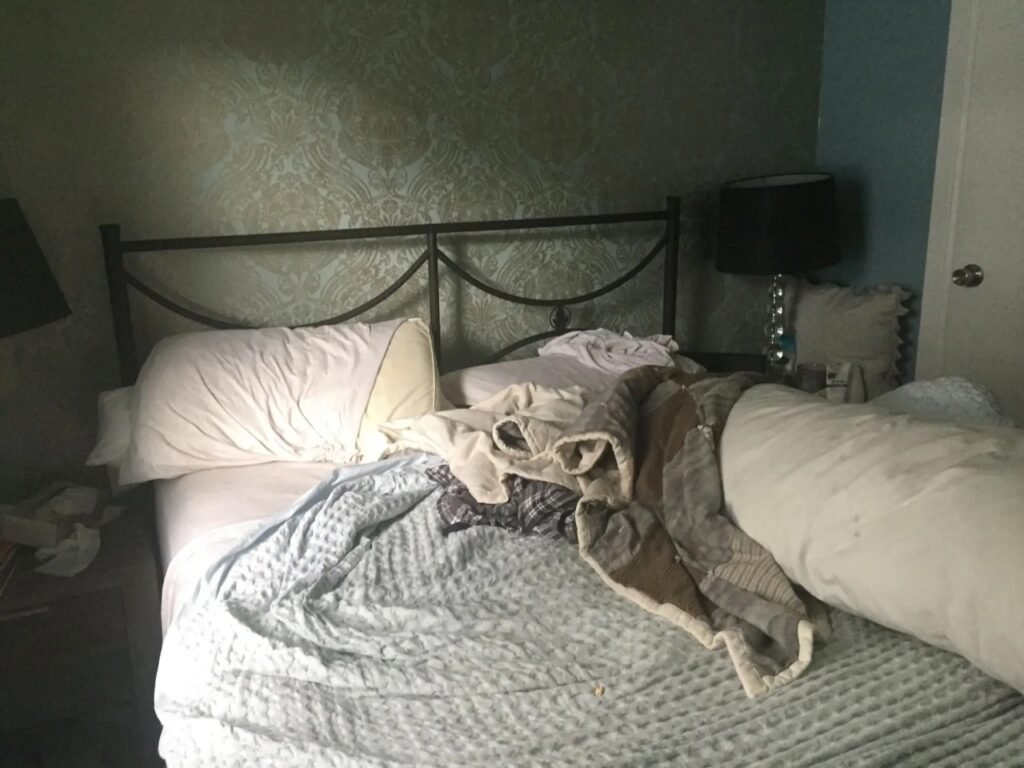
Let me rewind about eighteen months. If you had walked into my bedroom back then, you wouldn’t have seen a sanctuary. You would have seen a crime scene of consumerism. There was a “chair-drobe” (you know the one—the chair that exists solely to hold seventeen half-worn hoodies), a nightstand that hadn’t seen its own surface since the Obama administration, and a closet that sighed audibly every time I opened it.
I was waking up tired. Not just “I need coffee” tired, but a deep, claustrophobic kind of exhaustion. I’d lie in bed staring at a pile of unopened mail on my dresser, a dead succulent in a ceramic pot, and three different types of lotion bottles that were all 98% empty. My brain felt like a browser with forty-seven tabs open, and every single tab was just a picture of the laundry I was ignoring.
The breaking point came on a random Tuesday. I was looking for my car keys. They weren’t in my jacket. They weren’t on the hook. After fifteen minutes of frantic digging under a pile of gym bags and old receipts, I found them inside a coffee mug on my bookshelf. A coffee mug. On a bookshelf. That was the moment I realized: I had lost control of the physical space, and therefore, I had lost control of my peace of mind.
That weekend, I didn’t go to Target. I didn’t buy a fancy storage solution from The Container Store. Instead, I sat on the floor of my disaster-zone bedroom with a single trash bag and a “Maybe” box. I wasn’t trying to be an influencer. I was just trying to breathe.
The Great Purge: Crying Over Scented Candles
Here is the truth they don’t tell you on Pinterest. Minimalism is not about owning nothing. It’s about noticing how much of your stuff actually hates you.
I started with my nightstand. I pulled out ten pens, only two of which worked. I found seven phone chargers that were frayed at the ends. I found a candle that smelled like “Vanilla Bourbon Maple” that gave me a headache every time I lit it. Why was I keeping it? Because I paid twelve dollars for it two years ago. The Sunk Cost Fallacy, folks. It ruins lives.
I held that candle for a solid three minutes. I sniffed it. I felt guilty. Then I threw it in the trash. And do you know what happened? The world didn’t end. The minimalism police didn’t break down my door. I just felt lighter.
Moving to the closet was the real therapy session. I pulled out every single piece of clothing I owned and threw it onto the bed. It looked like a H&M had exploded. I asked myself the Marie Kondo question: “Does this spark joy?” But honestly, I modified it. I asked, “Does this fit? Have I worn it since 2019? Would I buy this again today?”
The “chair-drobe” went first. Those three hoodies that are faded and pilled? Gone. The jeans that are “in case I lose five pounds”? Donated. The t-shirts I got for free from tech conferences? Recycled into rags for cleaning my bike.
When I was done, I had reduced my wardrobe by about 60%. I hung everything back up, but this time, I left space between the hangers. It looked like a store display. It looked calm. I stood there for five minutes just looking at it.
The Rules of the Empty Floor
Now, I’m not a monk. I don’t live in a white room with a single bowl of water for sustenance. But I did adopt a few hard rules during the setup phase that changed everything.
Rule One: The Floor is not a Shelf.
We treat floors like purgatory. “I’ll put that away later.” Later never comes. My new rule is that nothing—and I mean nothing—touches the floor except furniture legs and my bare feet when I get out of bed. That gym bag that usually lives by the door? It got a hook. That stack of books? They went to the library or the bookshelf. Walking across my bedroom now is like walking across a frozen lake—smooth and deliberate.
Rule Two: One Touch Rule.
This is for the clutter that used to live on my dresser. Mail, receipts, random screws (why were there always random screws?). The rule is simple: when you pick something up, you deal with it immediately. Mail comes in? Trash the envelope, pay the bill, file the letter. It takes fifteen seconds. That $20 bill I found crumpled in a drawer? That didn’t take any time at all to put in my wallet.

Building the Sanctuary (The Fun Part)
Once the debris was cleared, I had to actually design the calm. This was the hard part for me because I am, by nature, a maximalist. I like knick-knacks. I like colors. I had to learn that “less” doesn’t mean “cold.”
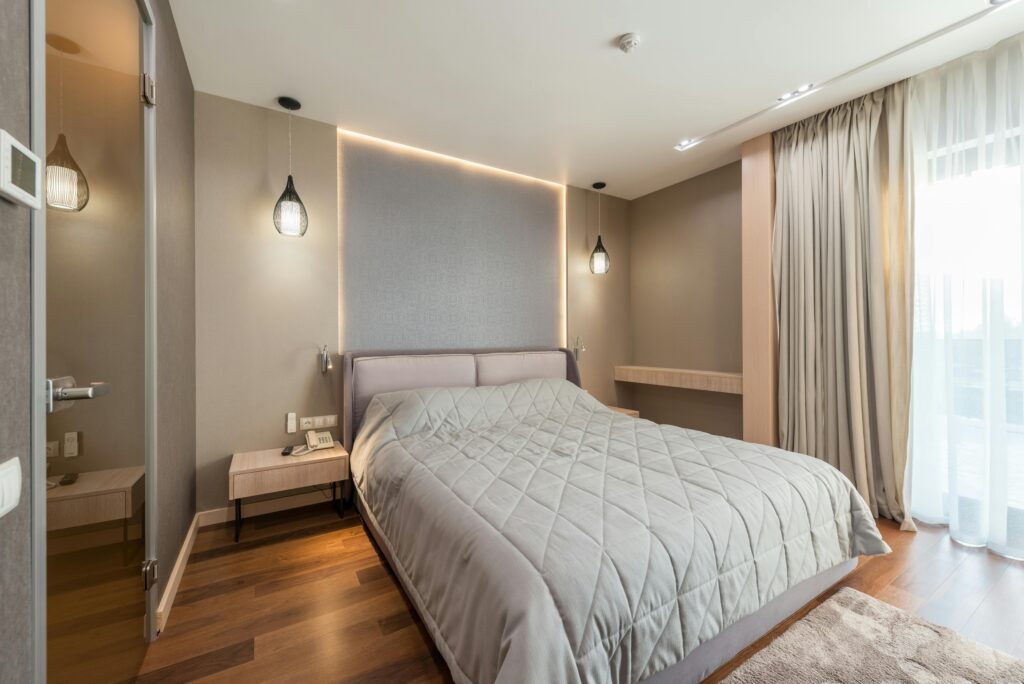
I painted the walls. Not white, but a color called “Ship’s Gray.” It’s a soft, almost blue-gray that changes with the light. It makes the room feel like a deep breath. If you can’t paint, that’s fine, but you need to neutralize the chaos. Bright orange walls full of posters? That’s energy. A bedroom should be rest.
I bought one piece of art. Not a gallery wall with seventeen tiny frames that get dusty and crooked. One large canvas. It’s an abstract landscape of a foggy forest. It cost me forty dollars at a local market. It is the only thing on my walls. When I look at it, my brain shuts up.
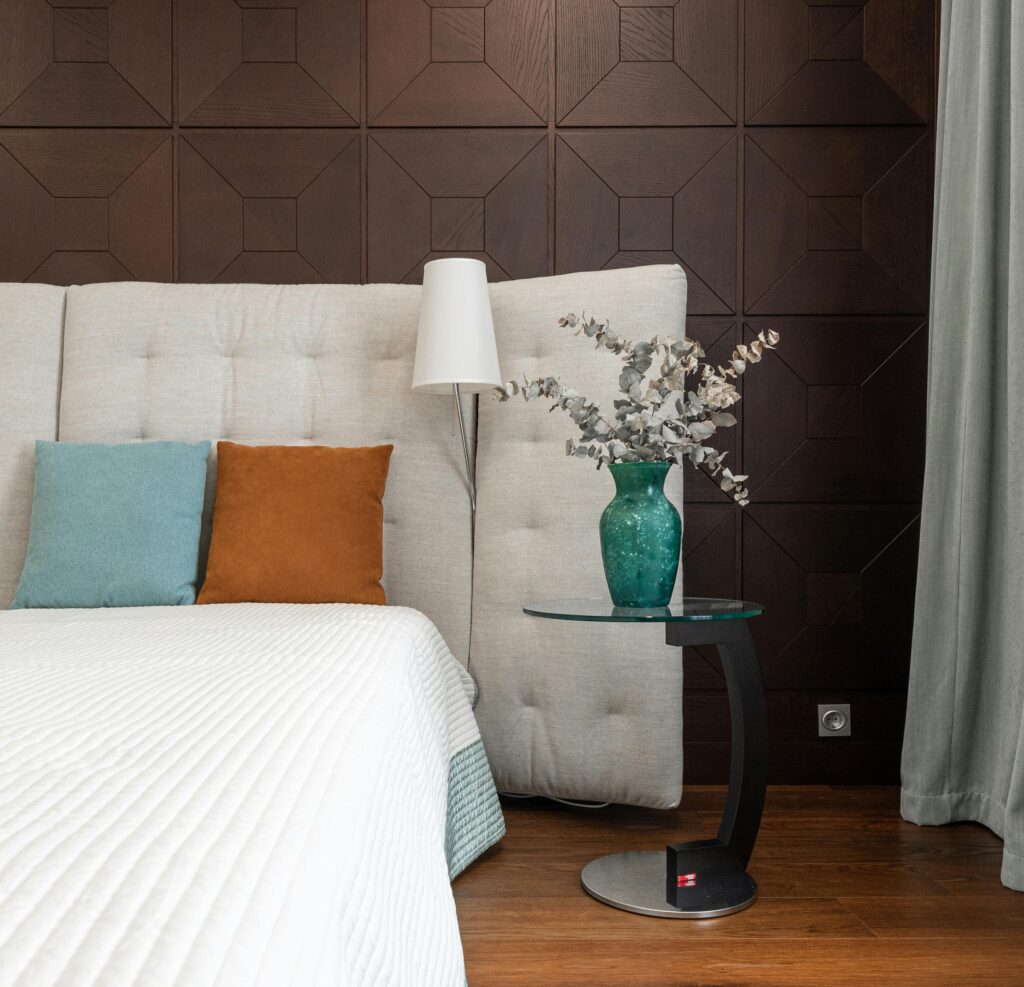
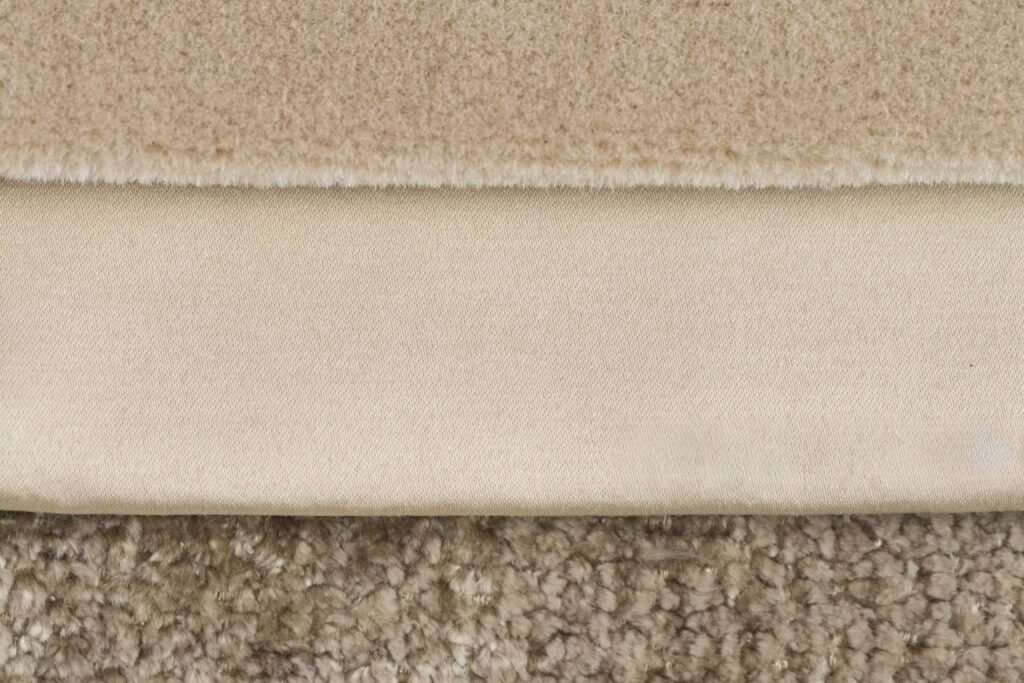
The bed became the star. I invested in good sheets—not expensive, necessarily, but good. 100% cotton, high thread count, crisp white. White sheets are terrifying at first. “I’ll stain them!” you think. But white sheets force you to be clean. They show you the dirt. Plus, they bleach easily. I added one textured throw blanket at the foot of the bed—a chunky knit in a dusty oatmeal color. And two pillows. That’s it. No line-up of decorative shams that you have to remove every night. No stuffed animals (I’m 38, it was time). Just sleep geometry.
The Lighting Secret
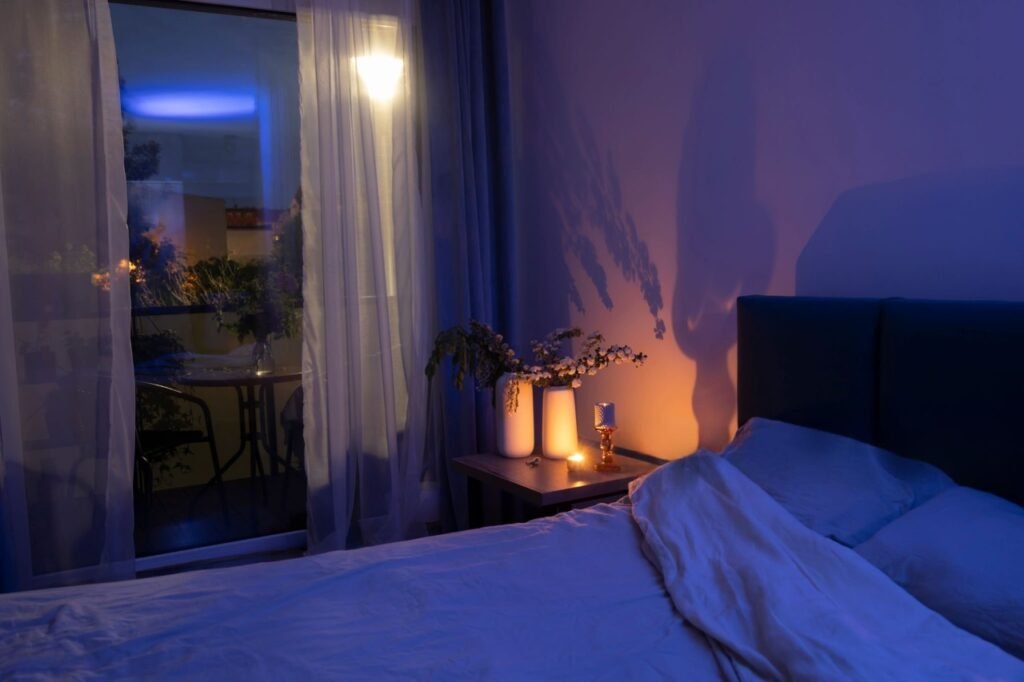
Most people ruin their minimalist bedroom with the lights. They get a ceiling fan with a bright, cool-toned LED bulb. It looks like an operating room. You don’t want an operating room; you want a cave.
I took the bulbs out of my overhead light. I haven’t turned that light on in a year. Instead, I have three sources of warm light:
- A small salt lamp on the dresser (amber, dim).
- A plug-in sconce above the bed (directed down, for reading).
- A strand of very low-wattage fairy lights tucked behind the headboard.
That’s it. At night, the room glows. It doesn’t shine. This is the difference between a bedroom and a waiting room. Light should be a whisper, not a shout.
The Maintenance Phase: Where Most People Fail
Look, I’d love to tell you that after I set this up, I became a perfect human who makes my bed every morning at 6 AM while sipping matcha. I do not. I am a gremlin who sleeps in until the last possible second.
But here is the mechanical trick that keeps the minimalism alive: The Reset Timer.
Every night, right before I brush my teeth, I take sixty seconds. That’s it. One minute. I scan the room. Is there a water glass on the nightstand? Goes to the kitchen. Are my shoes by the door? Kicked into the closet. Is that one sock under the desk? Thrown in the hamper.
Sixty seconds of “closing duties.” Just like a restaurant kitchen cleans the grill at the end of the night, I clean my floor. Because I learned the hard way that if I skip one night, it’s fine. If I skip three nights, I wake up to a pile of receipts, a granola bar wrapper, and a sense of impending doom.
The Emotional Payoff (Why This Actually Matters)
I was on a video call with my mom last week. It was morning. My room was messy—the blankets were bunched up, my laptop was on the bed, and my hair looked like I’d wrestled a cat. But my mom paused and said, “Wow. Your room looks so peaceful. You look calmer.”
She was right. I don’t lose my keys anymore. I don’t step on Legos (I don’t have kids, but the metaphor stands). When I walk into my bedroom after a ten-hour workday, my shoulders drop. There is no visual noise. There is no pile of “to-do” items staring at me from the dresser. There is just the gray wall, the foggy forest painting, and the crisp white bed.
I sleep better. I wake up clearer. It sounds like new-age nonsense, but it’s just physics. When your external environment is chaotic, your internal monologue becomes chaotic. You can’t think straight if you can’t see straight.
A Confession

I still have a junk drawer. It’s in the kitchen, where it belongs. And my closet? It got a little messy again last month. I bought two new sweaters. The hangers got crowded. I felt the old anxiety creeping back in. So yesterday, I did another ten-minute purge. Two sweaters left, one stayed. Back to balance.
Minimalism isn’t a destination. You don’t “arrive” at a perfect white box and then die. It’s a constant editing process. It’s saying “no” to the free t-shirt. It’s throwing out the candle that gives you a headache. It’s taking sixty seconds to put the sock in the hamper.
So, here is my minimalist bedroom setup guide, boiled down from 2,000 words to just three sentences: Clear the floor. Warm the light. Put it back when you’re done.
If I can do it—a guy who once stored car keys in a coffee mug—you can definitely do it.
I still have a junk drawer. It’s in the kitchen, where it belongs. And my closet? It got a little messy again last month. I bought two new sweaters. The hangers got crowded. I felt the old anxiety creeping back in. So yesterday, I did another ten-minute purge. Two sweaters left, one stayed. Back to balance.
Minimalism isn’t a destination. You don’t “arrive” at a perfect white box and then die. It’s a constant editing process. It’s saying “no” to the free t-shirt. It’s throwing out the candle that gives you a headache. It’s taking sixty seconds to put the sock in the hamper.
So, here is my minimalist bedroom setup guide, boiled down from 2,000 words to just three sentences: Clear the floor. Warm the light. Put it back when you’re done.
If I can do it—a guy who once stored car keys in a coffee mug—you can definitely do it.
Three Short FAQs
1. What if I live in a tiny studio apartment and my “bedroom” is also my living room?
Then you are playing the game on hard mode, my friend. For you, minimalism isn’t about empty space; it’s about separation. Use a room divider (a cheap IKEA kallax shelf works wonders) or a heavy curtain to create a visual break. When you’re in bed, you don’t want to see the dishes. Also, invest in under-bed storage with lids. If the floor is tiny, the vertical space under your mattress is prime real estate.
2. I have a partner/kid/dog that makes messes. How do I stay minimalist without being a controlling jerk?
You don’t force them. You lead by example. Claim one surface as your “sacred space”—maybe it’s just your nightstand or your dresser top. Keep that zone perfect. Over time, I swear, people mimic calm. My partner still leaves shoes everywhere, but after seeing how relaxed I was, they started putting their phone charger away. Don’t nag. Just be the peace you want to see. (Also, get a closed hamper with a lid. Hide the chaos.)
3. Is it really okay to throw away sentimental stuff like old concert tickets or letters?
Don’t you dare throw away the good stuff. The point isn’t to erase your life; it’s to erase stress. Get a single, beautiful archival box. Not a plastic tote. A nice one. Put all the letters, ticket stubs, grandma’s brooch, and your kid’s first drawing inside. Put that box on the top shelf of your closet. The memories stay. The clutter on your nightstand goes. There is a massive difference between storage and littering. Respect your memories by storing them properly, not by letting them get coffee stains on your dresser.